
About
What Vedveer Arya's research establishes, the evidence behind it, how the dates are established, and the author.
1the Śaka era, 583 BCE
Indian chronology rests on three sheet anchors: 3162, 1864 and 583 BCE.
On this page
The thesis
Vedveer Arya's work shows that the accepted dates of world history are displaced: by more than six centuries in places, and by much more for ancient India. The case is made not by reinterpretation but from evidence that can itself be dated:
- the sky the old texts describe: eclipses, planetary positions, and the slow drift of the equinox through the nakṣatras, the 27 star groups of Indian astronomy;
- dated inscriptions, including the grants of land engraved on copper plates;
- royal genealogies kept in the Purāṇas and the epics;
- old river beds: the dry channels of rivers that the texts describe as flowing.
Two results recur. First, a 661-year error runs through the accepted dates wherever two eras were taken for one, above all the Śaka era and the Śakānta era. Second, Egypt's dates come out several centuries too young, because they are tied to the wrong rising of the star Sirius. Every date linked to Egypt moves with them.
A second, larger finding runs alongside: that the Indo-European languages and peoples spread out of India, not into it. It has its own section below, because it rests on different evidence and stands or falls on its own.
Where conventional chronology disagrees, its date is shown struck through.
The anchors
Vedveer Arya fixes Indian chronology to three dates: the Mahābhārata War in 3162 BCE, the Buddha's nirvāṇa in 1864 BCE, and the start of the Śaka era in 583 BCE. Two of the arguments carry most of the chronology.
Fact CardIndian chronology rests on three sheet anchors: 3162, 1864 and 583 BCEThe first: the Mahābhārata War in 3162 BCE
This is not an estimate but an exact year. It is worked out from three eclipses seen from the Kurukṣetra region, and from the positions of the planets that the epic records. It is checked against the traditional Saptarṣi calendar, which puts the Seven Sages in Maghā from 3176 to 3076 BCE, a century that takes in Yudhiṣṭhira's reign, and against his reading of the Aihole inscription of Pulakeśin II. Every Purāṇic king list counts from this year.
Fact Card3162 BCEThe Mahābhārata war was fought in 3162 BCEThe case has a page of its own, Date of the Mahābhārata War (3162 BCE): the eight tests, the three eclipses, the planets before the war and the sixteen proposed dates, scored.
The second: a 661-year error
The error is that two different eras were taken for one. Inscriptions record an early Śaka era, starting in 583 BCE, and a later Śakānta era (the name means “the end of Śaka”), starting in 78 CE. Historians treated the two as one era. Counting BCE years with a year 0, as astronomers do, the arithmetic of the mistake is the whole error:
The two Śaka eras
The Guptas: the conventional date, 319 CE ; the revised date, 334 BCE
A historian, counting without a year 0, writes 583 BCE as 584 BC. The gap to 78 CE is the same 661 years. Why a BCE year can differ by oneYears here are counted as astronomers count them, with a year 0 before 1 CE. History books have no year 0, so every BCE year in them is one higher: the Kaliyuga's start, 3101 BCE here, is 3102 BC in a history book.
Across the world's dates, the same error is set out on one Fact Card, listed with the others below.
The mistake makes whole dynasties look 661 years more recent than they were. The Guptas are the plainest
case: they began around 334 BCE, the date tradition gives, and conventional chronology
puts them in the conventional date, 319 CE. That chronology goes back to
1772, when Joseph de Guignes identified Sandrokottus, the Indian king the Greeks name as Alexander's
contemporary, with Chandragupta, and to 1793, when William Jones reinforced the identification with
Chandragupta Maurya. More
than 250 years later, the textbooks still follow it.
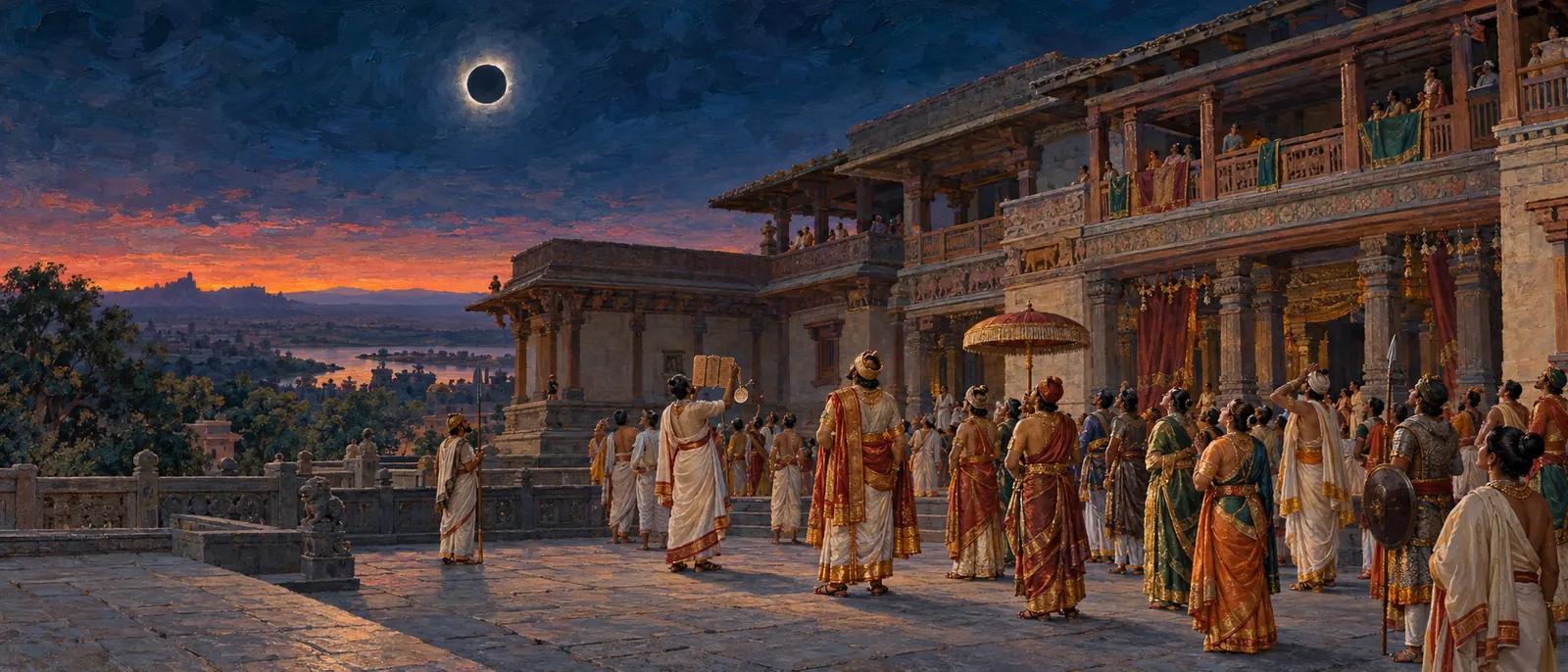
The start in 583 BCE rests chiefly on two pieces of evidence:
- the Kurtakoti copper plate, dated Śaka 530, which records the total eclipse of the sun of 9 May 53 BCE (The Chronology of India: From Mahabharata to Medieval Era, Vol. I, pp. 17–20);
- two copper plates from the Praṇaveśvara temple at Talagunda, one dated in each era, which show both eras in use at the same time.
One Fact Card gathers the argument, and 101 Evidences sets out more of it, inscription by inscription. Harihara I's Kapaluru and Yerragundi grants of Śaka 1258 date the founding of Vijayanagara (Vol. II, pp. 120–122).
- World chronology is displaced by 661 years
- The Guptas began about 334 BCE, not 319 CE: the Gupta–Sasanian synchronism reassessed
- Sandrokottus was Chandragupta of the Chandra dynasty, not Chandragupta Maurya
- 583 BCEThe Śaka era began on 20 March 583 BCE
- 78 CEThe Śakānta era began on 1 April 78 CE, an astronomers' epoch
- Two Śaka eras: the Śaka era of 583 BCE and the Śakānta era of 78 CE
the conventional date, 1336 CE; the revised date, 675 CEHarihara I was crowned at Vidyānagara on 8 April 675 CE
Conventional chronology still rests on the old dates.
The revised chronology, at a glance
These dates follow from them.
11864 BCE2583 BCE
- about 14400 BCEThe Early Vedic period begins, in the time of Brahmā I, the earliest Vedic astronomer
- about 14010 BCEPṛthu, the first consecrated king, organises agrarian society
- about 13950 BCEManu founds Ayodhyā on the Sarayū
- about 11150 BCEPārāśarya Vyāsa, the original Veda Vyāsa, compiles the four Vedas and the Paurāṇika Saṁhitā
- 22 February 6778 BCEAll seven classical planets meet in Aries, as the Sūrya Siddhānta records: the end of the 28th Kṛta Yuga, and the start of the seven-day week (20 February with ΔT)
- 3 December 6777 BCEThe Saptarṣi calendar begins, and with it the 28th Tretā Yuga
- 5677–5577 BCEThe Rāmāyaṇa Age: Śrī Rāma rules from Ayodhyā
- 3162 BCEThe Mahābhārata War: the 28th Dvāpara Yuga gives way to the Kaliyuga
- 1864 BCEThe Mahāparinirvāṇa of the Buddha, fixed by a recorded eclipse pair
- 1596 BCEAccession of Chandragupta Maurya
- 1189 BCEThe Nirvāṇa of Mahāvira
- 704 BCEThe assassination of Julius Caesar, fixed by the solar eclipse the Roman sources report
- 660 BCEThe birth of Jesus, marked by the Jupiter–Venus conjunction known as the Star of Bethlehem
- 334–89 BCEThe Gupta dynasty
- 8 April 675 CEVijayanagara is founded: Harihara I is crowned there on the date of his copper plates, Śaka 1258. Counted from 583 BCE, that year is 1258 − 583 = 675 CE
Two of these have pages of their own: the Rāmāyaṇa Age and the Mahābhārata War.
The Fact Cards give the evidence for each date, and on the Calendars page the day count counts days from the meeting of the planets on 22 February 6778 BCE (20 February with ΔT). The Earth's spin has slowed, so a sky computed for a distant year needs a correction, called ΔT. The day with ΔT, given beside a date, is the day as it fell in India.
Out of India
This is the second thesis, and the 2025 volumes are built on it: India is the homeland of the Indo-European languages and peoples. The movements the sources record run outward from the Sapta-Sindhu, the land of seven rivers in the north-west, not inward from the steppe.

The genetic evidence rests on the father-to-son (Y-chromosome) lineages R1a, R1b and J2, and on the mother-to-child (mtDNA) lineages M and U, which arose in India and spread from there across Eurasia. The textual evidence is a sequence of named migrations, each tied to an event the texts already date:
- about 13950 BCEAfter the defeat of Vṛtrāsura, the Dānavas, Daityas and Airyas leave the Sapta-Sindhu for the foothills of the Hindu Kush. By about 13000 BCE the Dānavas reach Anatolia and Greece and become the Danaans, the Danaoi of Homeric Greece
- about 11300 BCEIndra's victory over the Asura king Śambara drives Asuras (Airyas) to Airyanəm Vaējah, which Vedveer Arya places in Azerbaijan, the cradle of Iranian civilization
- 7400–7100 BCEThe Yavanas of Nysa, near Kabul, move into western Anatolia and become the Hittites
The geography is what makes the thesis checkable. The Rigvedic river Rasā is identified here with the Aras of the South Caucasus. That puts the Rigveda's knowledge of geography much further west than scholars usually allow. On the same reading, the Scythians, the Śakas, were not Central Asian nomads but an indigenous Indian warrior class from Sakasthan, in today's Afghanistan and Balochistan.
The Fact Card on the homeland, below, and the cards beneath it give the evidence for each migration, cited to the page, one piece at a time.
Fact CardIndia was the Indo-European homeland; civilizations predate 10000 BCEEgypt, and why it carries the rest
Egypt's dates hold up much of ancient history: Mesopotamia, the Levant and the Aegean are all dated by their links to Egypt. So an error in Egypt is never Egypt's alone. Everything tied to it moves with it.
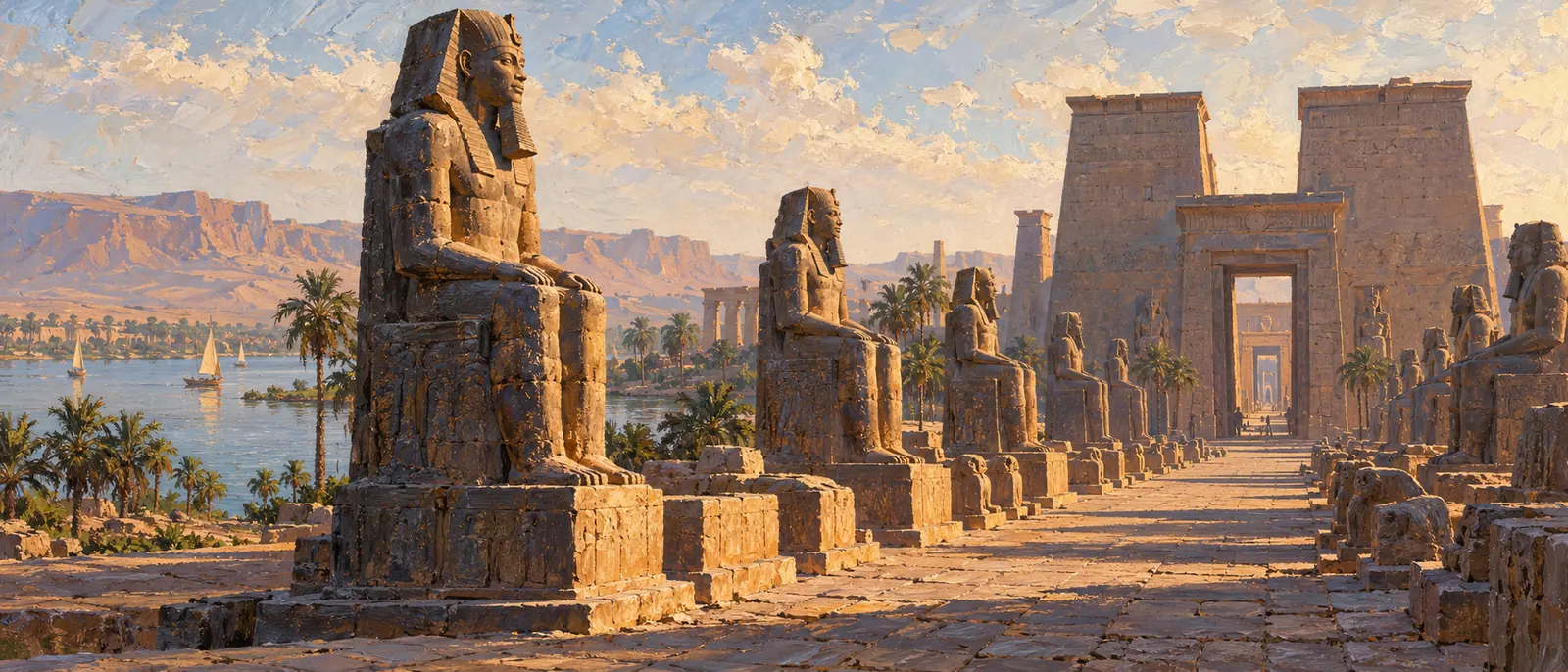
The Egyptian civil year had 365 days and no leap day. Its New Year's Day, 1 Thoth, therefore slipped one day every four years against the solar year, and came back to the same place after 1,460 years. To tie a date to that cycle, you have to decide which rising of the star Sirius the records describe. Egyptologists took them for heliacal risings: the first sight of Sirius just before dawn. They are midnight risings, and the cycle is anchored there:
1 Thoth, Cycle 1 = 26 September 3605 BCE, the midnight rising of Sirius.
On that anchor, the accepted Egyptian dates come out about 826 years too young. Egypt's own chronicles, above all Manetho's Aegyptiaca, preserve a long, real line of kings. Early writers, Eusebius among them, set those chronicles aside for a Biblical flood story that left no room for anything before about 3000 BCE.
Fact CardEgypt's Sothic calendar began at Sirius's midnight rising on 26 September 3605 BCEYou can also run the calendar yourself: the Egyptian calendar converter on the Calendars page turns a Julian date into its day in the Egyptian civil calendar, and back again, and explains how the calendar worked.
How the dates are established
Three kinds of evidence, used in a set order. The astronomy fixes exact points in time, and everything else is measured against them.
Astronomy in the records. Eclipses, meetings of planets and solstices recorded in texts and inscriptions. They fix the exact years, because they can be recalculated: an eclipse was visible from a given place on a given day, or it was not. The Archaeoastronomy page reads them case by case.
Inscriptions and king lists. Dated inscriptions and copper-plate grants, and the unbroken king lists of the Purāṇas. They give the order of events; tied to the astronomy, they give the years. 101 Evidences sets out 101 of them, one by one.
Old river beds. Satellite images and the geology of ancient rivers, the Sarasvatī above all. They show the landscape that the texts describe.
This gives a test for rival dating schemes. A real 365-day calendar, kept without a break, does not need reforming every few years. If a scheme needs repeated reforms, excuses about cloud cover or latitude, or one hand-picked date to make a record fit, the conclusion is that the scheme has failed, not the record.
One starting assumption is worth naming. The Vedas, the Purāṇas and the Itihāsas (the epics) are treated here as historical records to be tested, not as myth to be set aside before the testing starts.
Dated inscriptions are an enormous body of that evidence, still scattered across publications, museums and archives. Project Tāmraśilā sets out to bring them into one digital corpus, so that chronology can be tested against them directly.
Asking Chronology AI
An AI answers your questions from Vedveer Arya's books and papers (listed on the works page), and cites the book and page for every claim. As with any AI, check anything that matters against the pages it cites.
Asking needs a free account: 15 questions a week, up to 60 a month. Your chats are saved to your account, and your account page lets you download or delete them.
Your questions, with the chat's recent turns, go to Google's Gemini to write the answers; signing in is handled by WorkOS, and the site is served through Cloudflare.
Ask Chronology AIThe Fact Cards
The Fact Cards set out a selection of his findings as cards you can browse. Each card states one finding: what it is, the conventional date it revises (if there is one), how it is proved, its key passage quoted word for word, and the books it comes from.
The cards come in five levels, from the broadest to the most detailed:
- Core findings: the four claims the whole chronology rests on
- Threads: one finding traced through several of his works
- Works: what one book or paper establishes
- Chapters: what one chapter establishes
- Findings: one dated fact, with its proof
The author

Vedveer Arya
Chronologist, historian, Sanskrit scholar and civil servant
Vedveer Arya is a chronologist, historian, Sanskrit scholar, and civil servant whose research focuses on the reconstruction of Indian and global chronology through textual, astronomical, archaeological, epigraphic, and other multidisciplinary evidence.
Through meticulous research, Arya has exposed pivotal errors in mainstream historiography, revealing a staggering 661-year error in Indian and global chronology and a 1381-year error in the dating of the Buddha's nirvāṇa. His revelations are not mere academic debates; they fundamentally reorient our understanding of the civilizational past.
He is an officer of the Indian Defence Accounts Service (1997 batch) and has served as a senior official in the Ministry of Defence. He holds a postgraduate degree in Sanskrit from the University of Delhi, where he won the Dr Radhakrishnan Memorial Gold Medal and the C. D. Deshmukh Memorial Gold Medal, and he sits on the experts panel of Indian History Awareness and Research.
The published work
Vedveer Arya has published six books. Where a book is on sale, its links go to its page on Amazon.in.
- 2014Indian Contributions to Mathematics and Astronomy
- 2015The Chronology of Ancient India: Victim of Concoctions and Distortions Rewritten as The Chronology of India: From Mahabharata to Medieval Era
- 2019The Chronology of India: From Mahabharata to Medieval Era (two volumes) Amazon.in: Volume I (opens in a new tab) Volume II (opens in a new tab)
- 2019The Origin of the Christian Era: Fact or Fiction Amazon.in: paperback (opens in a new tab)
- 2025Chronology and Origins of Indo-European Civilizations (two volumes) Reconstructing 16,000 Years of Indo-Eurasian Past Amazon.in: hardcover, both volumes (opens in a new tab)
- 2026Chronology of India: From Manu to Mahabharata Reconstructing 16,000 Years of India's Civilizational Past. Published October 2026. Amazon.in: hardcover (opens in a new tab)
Published by Aryabhata Publications. His papers are listed on the works page.
