
Archaeoastronomy
The sky the oldest texts describe, dated by computing it. The first case: Ṛṣi Atri's total solar eclipse in the Rigveda, 29 June 11218 BCE.
1the war, 3162 BCE
29 June 11218 BCE: before the Rāmāyaṇa Age and the war. Drawn from Chronology of India: From Manu to Mahabharata, chapters 4, 7 and 9.On this page
How to read this page
- Years: 11218 BCE is a historian's 11219 BC.
- The calendar: Julian, the one the sky programs use for ancient dates; over so long a span it drifts against the seasons, so in 11218 BCE the vernal equinox fell in June.
- ΔT, about six days here, uncertain by up to a day: 29 June 11218 BCE (23 June with ΔT) and 24 December 11218 BCE (18 December with ΔT).
The Oldest Historical Solar Eclipse of Human History
29 June 11218 BCE (23 June with ΔT)The Earth's spin has slowed, so a sky computed for a distant year needs a correction, called ΔT. The day with ΔT, given beside a date, is the day as it fell in India.
Case 1, Rigveda 5.40
Atri's Observation of a Total Solar Eclipse During Samudra Manthan
The sky turned back to 29 June 11218 BCE
By his fourth sacred prayer Atri discovered Sûrya concealed in gloom that stayed his function.
Atri's eclipse in the Rigveda
Rishi Atri's Sukta in the Rigveda (5.40) contains a unique description of a total solar eclipse observed during the Rigvedic period:
यत्त्वा सूर्य स्वर्भानुस्तमसाविध्यदासुरः ।
अक्षेत्रविद्यथा मुग्धो भुवनान्यदीधयुः ॥
O Sûrya, when the Asura's descendant, Svarbhânu, pierced thee through and through with darkness,
All creatures looked like one who is bewildered, who knoweth not the place where he is standing.
स्वर्भानोरध यदिन्द्र माया अवो दिवो वर्तमाना अवाहन् ।
गूळ्हं सूर्यं तमसापव्रतेन तुरीयेण ब्रह्मणाविन्ददत्रिः ॥
What time thou smotest down Svarbhânu's magic that spread itself beneath the sky, O Indra,
By his fourth sacred prayer Atri discovered Sûrya concealed in gloom that stayed his function.
मा मामिमं तव सन्तमत्र इरस्या द्रुग्धो भियसा नि गारीत् ।
त्वं मित्रो असि सत्यराधास्तौ मेहावतं वरुणश्च राजा ॥
Let not the oppressor with this dread, through anger swallow me up, for I am thine, O Atri.
Mitra art thou, the sender of true blessings: thou and King Varuṇa be both my helpers.
ग्राव्णो ब्रह्मा युयुजानः सपर्यन्कीरिणा देवान्नमसोपशिक्षन् ।
अत्रिः सूर्यस्य दिवि चक्षुराधात्स्वर्भानोरप माया अघुक्षत् ॥
The Brahman Atri, as he set the press-stones, serving the Gods with praise and adoration,
Established in the heaven the eye of Sûrya, and caused Svarbhânu's magic arts to vanish.
यं वै सूर्यं स्वर्भानुस्तमसाविध्यदासुरः ।
अत्रयस्तमन्वविन्दन्नह्यन्ये अशक्नुवन् ॥
The Atris found the Sun again, him whom Svarbhânu of the brood
Of Asuras had pierced with gloom. This none besides had power to do.
The Brāhmaṇas and the equinox
A further description of this total solar eclipse, along with references to Svarbhānu, is also found in the Tāṇḍya Brāhmaṇa, Kauṣītaki Brāhmaṇa, Maitrāyaṇī Brāhmaṇa, Jaiminīya Brāhmaṇa, Śatapatha Brāhmaṇa, and Gopatha Brāhmaṇa.
The Kauṣītaki Brāhmaṇa (24.3-4) prescribes certain rituals before Viṣuvān (the equinox – Vernal or Autumnal) while referring to this total solar eclipse. This indirectly indicates that the date of the total solar eclipse was very close to the equinox.
स्वर्भानुर् ह वा आसुर आदित्यम् तमसा अविध्यत् । तस्य अत्रयस् तमो अपजिघांसन्त एतम् सप्तदश स्तोमम् त्र्यहम् पुरस्ताद् विषुवत उपायन् । तस्य पुरस्तात् तमो अपजघ्नुः । तत् परस्ताद् असीदत् । त एतम् एव त्र्यहम् उपरिष्टाद् विषुवत उपायन् । तस्य परस्तात्तमो अपजघ्नुः । तद् य एवम् विद्वांस एतम् सप्तदशस्तोमं त्र्यहम् उभयतो विषुवन्तम् उपयन्ति । …. यम् वै सूर्यम् स्वर् भानुस् तमसा अविध्यद् आसुरः । अत्रयस् तम् अन्वविन्दन् न ह्य् अन्ये अशक्नुवन्न् इति ।
29 June 11218 BCE (23 June with ΔT)
Taking these factors into account, astronomical simulations indicate that a remarkable total solar eclipse occurred on 29 June 11218 BCE (−11218) very close to the Vernal equinox.

- the eclipse, total, Hasta, 29 June 11218 BCE
- the equinox in 2026, Uttarabhādrapadā, 2026 CE
The Samudra-manthana
This total solar eclipse was observed during the Samudra-Manthana event at Mandara Parvat, near Bhagalpur, Jharkhand. According to the Purāṇic legend, when Maharṣi Dhanvantari emerged bearing the pot of amṛta, it was immediately seized by the Asuras. Viṣṇu, assuming the Mohinī form, employed divine stratagem to delude the Asuras and ensured that the nectar of immortality was distributed exclusively among the Devas. During this process, the Asura Svarbhānu infiltrated the ranks of the Devas in disguise and succeeded in partaking of the amṛta. However, Sūrya and Candra discerned the deception and alerted Mohinī, who swiftly severed Svarbhānu's head. Having already consumed the nectar, the severed head attained immortality and became Rāhu, while the headless body came to be known as Ketu. The legend further explains that Rāhu, driven by vengeance, perpetually pursues the Sun and Moon, symbolically accounting for eclipses.
This narrative, particularly the role of Svarbhānu and the simultaneous presence of Sūrya and Candra, strongly suggests an underlying memory of a total solar eclipse.

Astronomical simulations indicate that a remarkable celestial event occurred on 29 June 11218 BCE, when a total solar eclipse, with 100% obscuration, was visible at Mandara Parvat.

Six months later: 24 December 11218 BCE (18 December with ΔT)
Another major solar eclipse was recorded at Mandara Parvat on 24 December 11218 BCE (astronomical year −11218), within just six months of the earlier eclipse on 29 June 11218 BCE. Remarkably, this second eclipse occurred very close to the autumnal equinox, adding further astronomical significance to the sequence of events as described in the Kauṣītaki Brāhmaṇa (24.3-4).

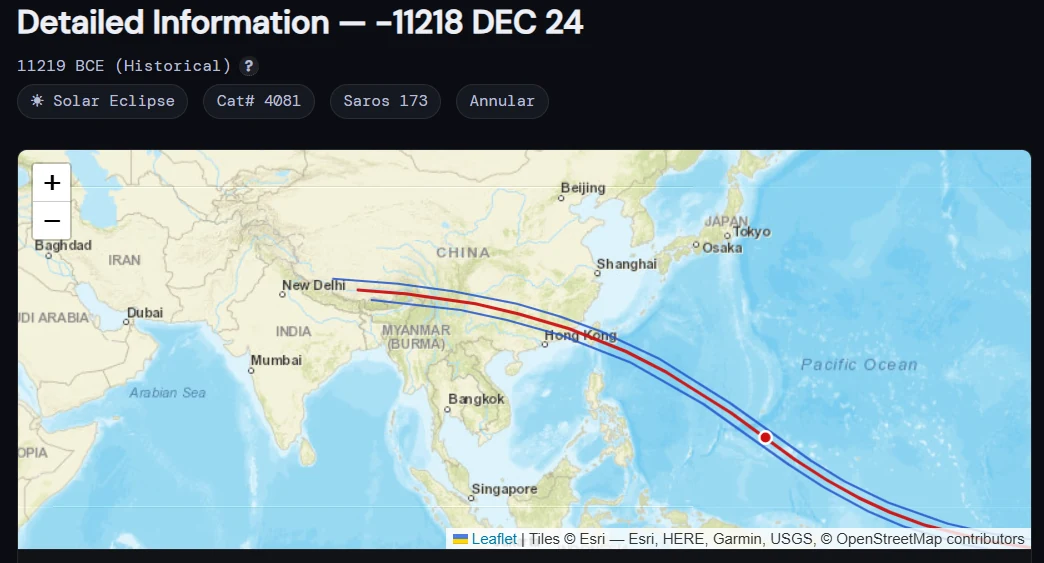
Astronomical simulations indicate that a remarkable celestial event occurred on 24 December 11218 BCE, when a solar eclipse, with 82.2% of the Sun's diameter obscured, was visible at Mandara Parvat.

Two Major Solar Eclipses of 11218 BCE and the Possible Origin of Rāhu (Ascending Lunar Node) and Ketu (Descending Lunar Node): An Archaeoastronomical Hypothesis
The occurrence of two major solar eclipses at Mandara Parvat on 29 June 11218 BCE (Total solar eclipse) and 24 December 11218 BCE (a solar eclipse with 82.2% of the Sun's diameter obscured) offers an intriguing hypothesis concerning the early development of Indian astronomical thought. According to the astronomical reconstruction under consideration, the two eclipses occurred close to the respective equinoctial periods. These two rare eclipses may provide a useful starting point for investigating whether repeated eclipse observations contributed to the early recognition of the two lunar nodes.
a node, where the Moon's path crosses the Sun's129 June 11218 BCE224 December 11218 BCE
A solar eclipse occurs when the New Moon passes sufficiently close to one of the two points at which the Moon's orbital plane intersects the ecliptic. These points, separated by 180° in ecliptic longitude, are conventionally designated the ascending and descending lunar nodes. Eclipse observations made at different positions along the Sun's apparent annual path could have helped observers recognise that solar eclipses were associated with two distinct regions of the celestial sphere. The interval between the proposed eclipses is approximately 178 days, broadly consistent with the recurrence of eclipse opportunities at alternate nodes, given that successive eclipse seasons are separated by about 173.3 days.
Within this hypothesis, sustained observations of solar and lunar eclipses may have encouraged the development of an empirical understanding of nodal positions and, eventually, approximate methods for predicting them. The conceptual distinction between the two nodes could conceivably have provided an astronomical foundation for their subsequent identification with Rāhu and Ketu, traditionally associated with eclipses in Indian astronomical thought.
The same astronomical concept may have been traditionally encoded in the form of a traditional legend. According to the Samudra Manthana legend, when Bhagavān Dhanvantari, the deity of Ayurveda, emerged with the Amṛta Kalaśa (pot of nectar of immortality), a dispute arose between the Devas and Asuras over its distribution. Lord Viṣṇu assumed the enchanting form of Mohinī and offered to distribute the nectar fairly. While Mohinī served the Devas first, the Asura Svarbhānu disguised himself and sat between Sūrya (Sun) and Chandra (Moon) to obtain the nectar. Upon being exposed by Sūrya and Chandra, Viṣṇu severed his head with the Sudarśana Chakra. However, having already consumed the nectar, Svarbhānu became immortal: his severed head became Rāhu, while his headless body became Ketu. Thereafter, Rāhu and Ketu became eternal adversaries of the Sun and Moon, periodically attempting to swallow them, thereby causing solar and lunar eclipses.
The two eclipses at a glance
29 June 11218 BCE: total, magnitude 1.0266
- First contact 01:52:05 UT
- Totality 03:05:32 to 03:06:23 UT, 51 seconds
- Last contact 04:28:59 UT
24 December 11218 BCE: partial, magnitude 0.8222, 82.2% of the Sun's diameter
- First contact before sunrise
- Greatest 00:38:06 UT
- Last contact 01:52:49 UT
| The eclipse | 29 June (23 June with ΔT) | 24 December (18 December with ΔT) |
|---|---|---|
| The year, as astronomers count it | −11218 | −11218 |
| The season | close to the vernal equinox | close to the autumnal equinox |
| The eclipse | total; catalogue no. 4080, Saros 168 | partial; catalogue no. 4081, Saros 173 |
| At Mandara Parvat | total, magnitude 1.0266 | partial, magnitude 0.8222 |
| First contact | 01:52:05 UT (07:48:30) | before sunrise |
| Totality | 03:05:32 to 03:06:23 UT (09:01:58 to 09:02:49), 51 seconds | none |
| Greatest eclipse | 03:05:57 UT (09:02:23) | 00:38:06 UT (06:17:34) |
| Last contact | 04:28:59 UT (10:25:26) | 01:52:49 UT (07:32:18) |
From his Figures 2, 3, 5 and 6 and eclipsedb.org, for Mandara Parvat (24.5028° N, 87.0207° E). UT is universal time; the local apparent time, in brackets, is the time a sundial there would show.
Sources
- The two passages: Rigveda 5.40.5–9, and Kauṣītaki Brāhmaṇa 24.3–4.
- The Brāhmaṇas his article names, at the places his book gives (notes 22 and 23 to chapter 4, p. 696): Tāṇḍya Brāhmaṇa 4.5.2, 4.6.13, 14.11.14 and 23.16.2; Kauṣītaki Brāhmaṇa 24.4; Maitrāyaṇī Brāhmaṇa 2.1.5, 2.5.2, 4.5.7 and 4.8.3; Jaiminīya Brāhmaṇa 1.80, 2.386 and 2.390; Śatapatha Brāhmaṇa 5.3.2; Gopatha Brāhmaṇa 2.3.19.
- The figures: Stellarium (Figures 1 and 4) and eclipsedb.org (Figures 2, 3, 5 and 6), as his article credits them.
- The English of the Rigveda's verses: R. T. H. Griffith, The Hymns of the Rigveda, 2nd ed., vol. I (Benares: E. J. Lazarus and Co., 1896), pp. 501–502.
The same eclipse in his book, with Jupiter in Makara and the tradition of the Kumbh at Prayāga: Chronology of India: From Manu to Mahabharata, chapter 4, pp. 181–183 and Figure 4.3.
