
The Rāmāyaṇa Age
Chapter 7 of From Manu to Mahabharata
The epic's own sky dates the age of Śrī Rāma to 5677–5577 BCE: the Sun, Mars and Rāhu together before the exile, and Halley's Comet beside Venus before its end.Why a BCE year can differ by oneYears here are counted as astronomers count them, with a year 0 before 1 CE. History books have no year 0, so every BCE year in them is one higher: the Kaliyuga's start, 3101 BCE here, is 3102 BC in a history book.
The Rāmāyaṇa Age, the 28th Tretā Yuga's last century. From p. 367 and pp. 373–374.
How to read this page
- Page numbers are those of Chronology of India: From Manu to Mahabharata (2026), its chapter 7 and Appendix II; a few passages come from its chapters 2, 4, 8 and 9 and say so.
- BCE years are counted as astronomers count them, with a year 0: 3101 BCE here is a historian's 3102 BC. Ancient dates are Julian.
- ΔT, the Earth's slowing spin, puts a computed day one or two days earlier in the Rāmāyaṇa Age; with the ΔT switch on, each date also shows that day: Rāvaṇa fell on 12 December 5635 BCE, 11 December with ΔT.
- A nakṣatra is one of the 27 star groups the Moon passes through each month, and a pāda a quarter of one; a tithi is a lunar day; Rāhu is the point where the Moon's path crosses the Sun's, counted among the planets.
- His words stand beside a rule, with their page. Verse numbers are those of the Gita Press edition of the Vālmīki Rāmāyaṇa: other editions number it differently.
Seventh Mahāyuga (7322 BCE) and the Rāmāyaṇa Age (5677–5577 BCE)
Interestingly, the astronomical observation of a comet and a planet in Mūla nakṣatra in the year of the Rāma–Rāvaṇa war, together with the conjunction of the Sun, Mars, and Rāhu in the year when Śrī Rāma departed from Ayodhyā for vanavāsa, provides a coherent framework for dating the events of the Rāmāyaṇa era. p. 392
On this page
The seventh Mahāyuga
7322 BCEThe Vedic calendar counted time in nested cycles of 5, 20 and 1,000 years, from about 13322 BCE. When the seventh thousand-year cycle, the seventh Mahāyuga, began in 7322 BCE, the winter solstice had moved to the nakṣatra Aśvinī, and the 27 nakṣatras were counted from it (p. 360). Its 28th cycle of four Yugas, or ages, holds the Rāmāyaṇa.
The seventh Mahāyuga, 7322 to 3162 BCEIn gold: the 28th Tretā
127 cycles of 20 years and the Kṛta
The 28th Tretā Yuga, 1,200 yearsIn gold: the Rāmāyaṇa Age
The Rāmāyaṇa Age, 100 yearsIn gold: Rāma's life
Rāma's life, his birth to his coronation, 5675 to 5634 BCEIn gold: the fourteen years
The fourteen years of exile, 14 years
The seventh Mahāyuga, 7322 to 3162 BCEIn gold: the Rāmāyaṇa Age
127 cycles of 20 years and the Kṛta
The Rāmāyaṇa Age, 100 yearsIn gold: the fourteen years
The fourteen years of exile, 14 years
1Rāma leaves Ayodhyā, 26 November 5649 BCE2Rāma is crowned, 15 January 5634 BCE
The seventh Mahāyuga (commenced in 7322 BCE) was designated after Vaivasvata Manu, not as a contemporaneous marker, but as a symbolic attribution.
6777–5577 BCEA Tretā Yuga of 1,200 years
A major astronomical reform is attributed to Mayāsura, who is said to have observed a rare planetary alignment on Caitra Śukla Pratipadā (22 February 6778 BCE) and composed the Sūrya Siddhānta.
With the introduction of the 12-year Jovian cycle, the astronomical schools of Brahma and Paitāmaha Siddhāntas expanded the Yuga to 1200 years (100 Jovian cycles) beginning 6777 BCE, facilitating more precise calendrical computations.
In this chronology of the seventh Mahāyuga, the 28th Kṛta Yuga lasts only five years (6782–6777 BCE), while the 28th Tretā Yuga extends for 1,200 years (6777–5577 BCE).
Thus, the calendar cycle remained as a 5-year cycle, but the Yuga cycle expanded to 1200 years.
Chapter 2, which works the conjunction out, dates it 22 February 6778 BCE (20 February with ΔT):
Software simulations using NASA’s JPL DE441 Ephemeris System indicate that such a planetary conjunction, with the Sun positioned in the first degree of Aries, occurred only once on 22 February 6778 BCE, [20 February 6778 BCE, with Δ T from Morrison & Stephenson (2004)] within the last 20000 years.
Fact Card7322–3176 BCEThe seventh Mahāyuga began in 7322 BCE and its 28th Kaliyuga in 3176 BCE
7423 BCEMegasthenes' 6,451 years from Dionysus
Classical Greco-Roman writers such as Pliny the Elder and Solinus, drawing on Megasthenes’ Indica, report that Indians counted 6451 years and about 153–154 kings from Dionysus (Bacchus) to Alexander (identified as Sandrocottus).
It appears that using the Seleucid epoch (972 BCE), Greek calculations yield a date of 7423 BCE for Dionysus (7423–972 = 6451), which broadly aligns with the traditional Indian reckoning of the beginning of the seventh Mahāyuga around 7322 BCE.
Prior to the Gupta period, Indian historians generally maintained the genealogical history starting from 7322 BCE.
Fact Card1596–925 BCESandrokottus was Chandragupta of the Chandra dynasty, not Chandragupta Maurya
Two kings, one name
Ayodhyā had kings long before 7322 BCE: tradition has Manu found it about 14000–13900 BCE (p. 361). The later Purāṇas, India's traditional histories, took Vaivasvata Manu for a man of 7322 BCE and set the early kings into the later line, beside later kings of the same names. Vedveer Arya separates them again: Table 7.4 sets each early king beside his namesake.
However, later Purāṇic redactors seem to have conflated this symbolic naming with historical chronology, assuming Vaivasvata Manu to belong to the epoch beginning in 7322 BCE. This interpretive shift likely influenced the restructuring of royal genealogies, particularly those of the Ikṣvāku dynasty.
As a consequence, the political history of the intervening period (10900–7322 BCE) appears very fragmented or absent in the extant Purāṇic tradition.
| Pair | Early king | Later namesake | Page |
|---|---|---|---|
| 1 | Triśaṅku I 13350 BCE Triśaṅku I, son of Tryāruṇa and grandson of Traivṛṣṇa, is the earliest known king of Ayodhyā. He is described as a contemporary of Viśvāmitra I, the father of Śakuntalā and grandfather of Bharata. | Satyavrata Triśaṅku II 6630–6600 BCE Satyavrata or Satyaratha, son of Tryāruṇa and grandson of Tridhanvan, is described as a later descendant of Ikṣvāku. | p. 369 |
| 2 | Hariścandra I 11250 BCE Hariścandra I, a descendant of Triśaṅku, is described in the Aitareya Brāhmaṇa as having vowed to sacrifice his son Rohita to Varuṇa. Rohita, however, fled to the forest to avoid the sacrifice. In his place, Śunaḥśepa, the son of Ajīgarta, was offered as a substitute but was ultimately spared through divine intervention. Thereafter, Ṛṣi Viśvāmitra is said to have adopted Śunaḥśepa. | Hariścandra II 6600–6570 BCE Hariścandra II, renowned as Satya Hariścandra, is celebrated for his unwavering commitment to truth and duty. His wife was Tārāmatī, and his son was Rohitāśva. In fulfilment of a vow, he relinquished his kingdom to Ṛṣi Viśvāmitra. Thereafter, he endured severe trials—selling his wife and serving at a cremation ground—yet remained steadfast in his principles. Ultimately, he was restored to his throne as king of Ayodhyā. | p. 370 |
| 3 | Vikukṣi 11230 BCE Vikukṣi was the eldest son of Ikṣvāku and the grandson of Vaivasvata Manu. | Śaśāda 7322–7300 BCE Śaśāda was a later descendant of Ikṣvāku. The well-known episode involving the consumption of a rabbit (śaśa), from which he derives his name, is associated with him, not Vikukṣi. | p. 370 |
| 4 | Purañjaya 11210 BCE Purañjaya is described as having assisted Indra in the war between the Devas and Asuras. In recognition of this, he earned the epithet Indravāha. | Kakustha 7300–7270 BCE Kakutstha was a celebrated later descendant of Ikṣvāku. His lineage came to be known as the Kākutsthas, a designation that extends to his illustrious descendants, including Śrī Rāma. | p. 370 |
| 5 | Saudāsa Kalmāṣapāda 11220 BCE Saudāsa Kalmāṣapāda is described as having developed deep enmity toward Vasiṣṭha and his lineage, culminating in the slaying of Śakti, the son of Vasiṣṭha. | Saudāsa Mitrasaha 6020–6000 BCE Saudāsa Mitrasaha’s queen, Madayantī, is said to have conceived a son, Aśmaka, through niyoga with Vasiṣṭha. Aśmaka later established a kingdom at Paudanyapura or Baudhāyanapura (identified with present-day Bodhan in Telangana) on the banks of the Godāvarī, which came to be known as the Aśmaka Janapada. | p. 370 |
| 6 | Kuvalāśva I 11190 BCE Kuvalāśva I is said to have slain Dhundhu—traditionally described as a son of Madhu and Kaiṭabha—in battle. | Kuvalāśva II 7100–7070 BCE Kuvalāśva II was a later descendant of Ikṣvāku. | p. 371 |
| 7 | Māndhātā I 11150 BCE Māndhātā I was a renowned king of the Vedic period. His son Mucukunda is traditionally regarded as a contemporary of Devakīputra Kṛṣṇa. | Māndhātā II 6880–6850 BCE Māndhātā II was a later descendant of Ikṣvāku. | p. 371 |
| 8 | Sagara I 10980 BCE Sagara I, the posthumous son of King Asita, is portrayed as a pivotal figure in the Ikṣvāku lineage. Prior to his reign, the descendants of Ikṣvāku—from Ikṣvāku himself to Asita—are associated with rule over Madhyadeśa. Sagara is credited with establishing the royal authority of the Ikṣvāku dynasty in Ayodhyā. | Sagara II 6370–6340 BCE Sagara II, the son of Bāhu, is described as a later descendant of Ikṣvāku. | p. 371 |
| 9 | Bhagīratha I 10940 BCE Bhagīratha I was a celebrated king of Ayodhyā, renowned for clearing the channel from Gangotri to Devaprayāga to bring the waters of the Gaṅgā to the plains. Aṣṭāvakra, the grandson of Uddālaka Āruṇi, is traditionally regarded as his mentor. Uddālaka Āruṇi was a contemporary of Videha king Janaka. | Bhagīratha II 6280–6250 BCE Bhagīratha II, the son of Aṁśumān, is described as a later descendant of Ikṣvāku. | p. 371 |
| 10 | Hiraṇyanābha Kauśalya 11000 BCE Hiraṇyanābha Kauśalya of the Vedic period is described as a disciple of Jaimini II (Sukarman) and a contemporary of Ṛṣi Pippalāda. | Hiraṇyanābha and Kauśalya 5040–4970 BCE Hiraṇyanābha is described as the father of Kauśalya; both are regarded as descendants of Śrī Rāma and are placed in the post-Rāmāyaṇa period. | p. 371 |
It is evident from the foregoing discussion that the Purāṇic redactors conflated the histories of several Ayodhyā kings bearing similar names.
The kings before 7322 BCE
13400–11160 BCEThe first kings of Ayodhyā
The Indian historical tradition preserved in the Itihāsa–Purāṇa corpus records that Ayodhyā was founded by Manu during the age of the 33 Devas around 14000-13900 BCE.
From a Rigveda hymn that names Traivṛṣṇa Tryāruṇa among its seers, the son of Trivṛṣṇa:
On this basis, an early dynastic sequence of Ayodhyā may be tentatively reconstructed as follows: Trivṛṣṇa (13400 BCE), Tryāruṇa (13375 BCE), and Triśaṅku (13350 BCE).
The well-known episode of Śunaḥśepa and King Hariścandra, preserved in the Aitareya Brāhmaṇa, belongs to the period of 11225 BCE.
Anaraṇya, identified as the son (or successor) of Kalmāṣapāda, is later mentioned in the Mahābhārata and Purāṇas as having been killed by Rāvaṇa I.
| Number | King | Reign |
|---|---|---|
| 1 | Vedhas | 11270–11250 BCE |
| 2 | Hariścandra | 11250–11220 BCE |
| 3 | Rohita | 11220 BCE |
| 4 | Saudāsa Kalmāṣapāda | 11220–11190 BCE |
| 5 | Anaraṇya | 11190–11160 BCE |
11250–10940 BCEIkṣvāku's line, to Bhagīratha
Vaivasvata Manu (11260–11200 BCE) is traditionally associated with authority over regions corresponding to Saurāṣṭra and Madhyadeśa.
Asita, driven out of Madhyadeśa:
His posthumous son Sagara subsequently re-established royal authority, founding his rule in Ayodhyā (Kosala).
It appears that the name and traditions associated with the early Ikṣvāku king Bhajeratha were later conflated with those of Bhagīratha, a subsequent ruler of the Ikṣvāku dynasty.
| Number | King | Reign |
|---|---|---|
| 1 | Ikṣvāku | 11250 BCE |
| 2 | Vikukṣi | 11230 BCE |
| 3 | Purañjaya | 11210 BCE |
| 4 | Kuvalayāśva | 11190 BCE |
| 5 | Yuvanāśva | 11170 BCE |
| 6 | Māndhātā | 11150 BCE |
| 7 | Susandhi | 11120 BCE |
| 8 | Dhruvasandhi | 11100 BCE |
| 9 | Bharata | 11070 BCE |
| 10 | Asita | 11030 BCE |
| 11 | Sagara | 10980 BCE |
| 12 | Barhiketu, Suketu, Dharmaratha, and Pañcajana | 10960 BCE |
| 13 | Bhagīratha | 10940 BCE |
11000 BCEHiraṇyanābha Kauśalya, king and teacher
एते एव पूर्वे अहनी अभिजिदतिरात्रस्तेन ह पर आट्णार ईजे कौसल्यो राजा तदेतद्गाथयाभिगीतमट्णारस्य परः पुत्रोऽश्वं मेध्यमबन्धयत् हैरण्यनाभः कौसल्यो दिशः पूर्णा अमंहतेति...
King Hiraṇyanābha Kauśalya is described as a king of Kosala and a significant figure in the transmission of Vedic knowledge.
He was also the preceptor of Kṛta, who is credited with organizing twenty-four branches of the Sāmaveda.
The Śatapatha Brāhmaṇa indicates Para Āṭṇāra Kauśalya (11000 BCE) as a contemporary of the son of Hiraṇyanābha Kauśalya.
10900–7322 BCEThe lost centuries
The transition into the post-Vedic period was marked by major climatic disruptions, including the Younger Dryas (10700–9700 BCE) and the subsequent Meltwater Pulse 1B (9700–9300 BCE), which would have significantly affected patterns of settlement and continuity of tradition.
Of the later editors who placed Vaivasvata Manu about 7322 BCE:
This mistaken shift likely contributed to the loss of the genealogical records of the post-Vedic period.
These references suggest that additional rulers of the Ikṣvāku line flourished during the post-Vedic period but were later omitted or lost in the extant tradition.
6100–6080 BCEKing Ṛtuparṇa: one father, three names
Another issue is the variation in nomenclature, whereby the same king is referred to by different names across textual traditions.
A representative example is King Ṛtuparṇa (6100–6080 BCE), who is described as a contemporary of King Nala and Queen Damayantī. The Baudhāyana Śrautasūtra and Āpastamba Śrautasūtra identify him as the son of Bhangaśvina, while the Mahābhārata refers to him as the son of Bhagasvara. In contrast, the Purāṇas name Ayutāyu as his father.
Sixty-two kings, Śaśāda to Śrī Rāma
From Śaśāda in 7322 BCE the line of Ayodhyā runs on unbroken, sixty-two kings to Śrī Rāma (p. 367). The Purāṇas list them with variations; Appendix II sets eight of their lists side by side.

Purāṇic genealogies enumerate approximately 62 kings from the commencement of the seventh Mahāyuga (7322 BCE) to Śrī Rāma (5635–5603 BCE).
In light of these factors, a careful reconstruction of the Ikṣvāku genealogy from Śaśāda to Śrī Rāma requires disentangling these errors and restoring the relative chronological sequence.
- 1Śaśāda7322–7300 BCE
- 2Kakustha7300–7270 BCE
- 3Anenāḥ7270–7250 BCE
- 4Pṛthu7250–7230 BCE
- 5Viṣṭarāśva7230–7200 BCE
- 6Ārdra7200–7180 BCE
- 7Yuvanāśva II7180–7150 BCE
- 8Śrāvasta (the founder of the city of Śrāvastī)7150–7120 BCE
- 9Bṛhadaśva7120–7100 BCE
- 10Kuvalāśva II7100–7070 BCE
- 11Dṛḍhāśva7070–7030 BCE
- 12Haryāśva I7030–7000 BCE
- 13Nikuṁbha7000–6980 BCE
- 14Saṁhatāśva6980–6950 BCE
- 15Kṛṣāśva6950–6920 BCE
- 16Prasenajit (Son of Kṛṣāśva)6920–6900 BCE
- 17Yuvanāśva III6900–6880 BCE
- 18Māndhātā II6880–6850 BCE
- 19Purukutsa (Son of Māndhātā II)6850–6820 BCE
- 20Trasadasyu or Duḥsaha6820–6800 BCE
- 21Saṁbhūta6800–6780 BCE
- 22Anaraṇya II6780–6760 BCE
- 23Pṛṣadaśva6760–6740 BCE
- 24Haryāśva II6740–6720 BCE
- 25Sumanāḥ or Sudhanvā6720–6690 BCE
- 26Tridhanvā6690–6660 BCE
- 27Tryāruṇi6660–6630 BCE
- 28Satyavrata Triśaṅku II6630–6600 BCE
- 29Hariścandra II6600–6570 BCE
- 30Rohitāśva6570–6540 BCE
- 31Hārīta6540–6510 BCE
- 32Cañcu6510–6480 BCE
- 33Vijaya6480–6450 BCE
- 34Ruruka6450–6420 BCE
- 35Vṛka6420–6390 BCE
- 36Bāhu6390–6370 BCE
- 37Sagara II6370–6340 BCE
- 38Asamañjasa6340–6320 BCE
- 39Aṅśumān6320–6300 BCE
- 40Dilīpa I6300–6280 BCE
- 41Bhagīratha II6280–6250 BCE
- 42Śruta or Prasuśruta or Prasuśruka6250–6220 BCE
- 43Nābhāga6220–6200 BCE
- 44Ambarīṣa6200–6170 BCE
- 45Sindhudvīpa6170–6130 BCE
- 46Ayutāyu or Bhangaśvina or Bhagasvara6130–6100 BCE
- 47Ṛtuparṇa6100–6080 BCE
- 48Sarvakāma Ārtaparṇi6080–6050 BCE
- 49Sudāsa6050–6020 BCE
- 50Saudāsa Mitrasaha6020–6000 BCE
- 51Aśmaka6000–5970 BCE
- 52Mūlaka5970–5950 BCE
- 53Śataratha or Narikavaca5950–5920 BCE
- 54Aiḍaviḍa or Nighna5920–5890 BCE
- 55Anamitra5890–5860 BCE
- 56Viśvasaha or Duliduha5860–5830 BCE
- 57Dilīpa II Khatvāṅga5830–5800 BCE
- 58Dīrghabāhu5800–5780 BCE
- 59Raghu5780–5730 BCE
- 60Aja5730–5710 BCE
- 61Daśaratha5710–5649 BCE
- Bharata (during the vanavasa of 14 years)5649–5635 BCE
- 62Śrī Rāma5635–5603 BCE
Appendix II: the line in eight Purāṇas, side by side (Table A2.1, pp. 673–676)
Although these texts generally preserve the same dynastic tradition, they exhibit variations in names, sequences, and omissions.
By comparing independent textual traditions, recurring names and succession patterns can be distinguished from isolated variants, while discrepancies can reveal where transmission has been affected.
| King | Vāyu | Brahmāṇḍa | Viṣṇu | Bhāgavata | Brahma | Harivaṁśa | Agni | Padma |
|---|---|---|---|---|---|---|---|---|
| 1 | Vikukṣi (Śaśāda) | Vikukṣi (Śaśāda) | Vikukṣi (Śaśāda) | Vikukṣi (Śaśāda) | Vikukṣi (Śaśāda) | Vikukṣi (Śaśāda) | Vikukṣi (Śaśāda) | Vikukṣi (a variant) |
| 2 | Kakustha | Kakustha | Kakustha (Purañjaya) (a variant) | Kakustha (Purañjaya) (a variant) | Kakustha | Kakustha | Kakustha | Kakustha |
| 3 | Anenāḥ | Anenāḥ | Anenāḥ | Anenāḥ | Anenāḥ | Anenāḥ | Suyodhana (a variant) | Suyodhana (a variant) |
| 4 | Pṛthu | Pṛthu | Pṛthu | Pṛthu | Pṛthu | Pṛthu | Pṛthu | Pṛthu |
| 5 | Vṛṣadaśva (a variant) | Dṛṣadaśva (a variant) | Viṣṭarāśva | Viśvagandhi (a variant) | Viṣṭarāśva | Viṣṭarāśva | Pṛthagaśva (a variant) | not listed |
| 6 | Āndra | Āndra | Āndra | Candra (a variant) | Ārdra (a variant) | Ārdra (a variant) | Āyu (a variant) | Ārdra (a variant) |
| 7 | Yuvanāśva | Yuvanāśva | Yuvanāśva | Yuvanāśva | Yuvanāśva | Yuvanāśva | not listed | Yuvanāśva |
| 8 | Śrāvasta | Śrāvasta | Śrāvasta | Śrāvasta | Śrāvasta | Śrāvasta | Śrāvasta | Śrāvasta |
| 9 | Bṛhadaśva | Bṛhadaśva | Bṛhadaśva | Bṛhadaśva | Bṛhadaśva | Bṛhadaśva | Bṛhadaśva | Bṛhadaśva |
| 10 | Kuvalāśva | Kuvalāśva | Kuvalāśva | Kuvalayāśva (a variant) | Kuvalāśva | Kuvalāśva | Kuvalāśva | Kuvalāśva |
| 11 | Dṛḍhāśva | Dṛḍhāśva | Dṛḍhāśva | Dṛḍhāśva | Dṛḍhāśva | Dṛḍhāśva | Dṛḍhāśva | Dṛḍhāśva |
| 12 | Haryāśva | Haryāśva | Haryāśva | Haryāśva | Haryāśva | Haryāśva | Haryāśva (son of Dṛḍhāśva) (a variant) | Haryāśva |
| 13 | not listed | Nikuṁbha | Nikuṁbha | Nikuṁbha | Nikuṁbha | Nikuṁbha | Nikuṁbha | Nikuṁbha |
| 14 | not listed | Saṁhatāśva | Amitāśva (Saṁhatāśva) (a variant) | Bāhulāśva (a variant) | Saṁhatāśva | Saṁhatāśva | Saṁhatāśva | Saṁhatāśva |
| 15 | not listed | Kṛṣāśva | Kṛṣāśva | Kṛṣāśva | Kṛṣāśva | Kṛṣāśva | Kṛṣāśva | Kṛṣāśva |
| 16 | Prasenajit | Prasenjit (a variant) | Prasenajit | Senajit (son of Kṛṣāśva) (a variant) | Prasenajit | Prasenajit | not listed | not listed |
| 17 | Yuvanāśva | Yuvanāśva | Yuvanāśva | Yuvanāśva | Yuvanāśva | Yuvanāśva | Yuvanāśva | Yuvanāśva |
| 18 | Māndhātā | Māndhātā | Māndhātā | Māndhātā | Māndhātā | Māndhātā | Māndhātā | Māndhātā |
| 19 | Purukutsa | Purukutsa | Purukutsa | Purukutsa | Purukutsa | Purukutsa | Purukutsa | Purukutsa |
| 20 | Trasadasyu | Yuvanāśva (a variant) | Trasadasyu | Trasadasyu | Trasadasyu | Trasadasyu | Trasadasyu | Duhsaha (a variant) |
| 21 | Saṁbhūta | Saṁbhūta | Saṁbhūta | not listed | Saṁbhūta | Saṁbhūta | Saṁbhūta | Saṁbhūta |
| 22 | Anaraṇya | Anaraṇya | Anaraṇya | Anaraṇya | not listed | not listed | not listed | not listed |
| 23 | Trasadaśva | not listed | Pṛṣadaśva (a variant) | not listed | not listed | not listed | not listed | not listed |
| 24 | Haryāśva | Haryāśva | Haryāśva | Haryāśva | not listed | not listed | not listed | not listed |
| 25 | Vasumat (a variant) | Sumati (a variant) | Sumanāḥ (a variant) | not listed | not listed | Sudhanva | Sudhanva | not listed |
| 26 | Tridhanvā | Tridhanvā | Tridhanvā | not listed | Tridhanvā | Tridhanvā | Tridhanvā | Tridhanvā |
| 27 | Tryāruṇa (a variant) | Tryāruṇi | Tryāruṇi | Tryāruṇa (a variant) | Tryāruṇi | Tryāruṇi | Tryāruṇi | Tryāruṇa (a variant) |
| 28 | Satyavrata Triśaṅku | Triśaṅku (a variant) | Satyavrata Triśaṅku | Satyavrata Triśaṅku | Satyavrata Triśaṅku | Satyavrata Triśaṅku | Satyavrata Triśaṅku | Satyavrata (a variant) |
| 29 | Hariścandra | Hariścandra | Hariścandra | Hariścandra | Hariścandra | Hariścandra | Hariścandra | Hariścandra |
| 30 | Rohitāśva (a variant) | Rohita | Rohitāśva (a variant) | Rohita | Rohita | Rohita | Rohita | Rohita |
| 31 | Hārīta | Hārīta | Hārīta | Hārīta | Hārīta | Hārīta | not listed | not listed |
| 32 | Hārīta Cañcu (a variant) | Hārīta Cañcu (a variant) | Cañcu | Campa (a variant) | Cañcu | Cañcu | not listed | not listed |
| 33 | Vijaya & Sudeva | Vijaya & Sudeva | Vijaya & Vasudeva (a variant) | Vijaya & Sudeva | Vijaya (a variant) | Vijaya & Sudeva | not listed | not listed |
| 34 | Ruruka (son of Vijaya) | Ruruka (son of Vijaya) | Ruruka (son of Vijaya) | Bharuka (son of Vijaya) (a variant) | Ruruka (son of Vijaya) | Ruruka (son of Vijaya) | not given | not listed |
| 35 | Hṛtak (a variant) | Vṛka | Vṛka | Vṛka | Vṛka | Vṛka | Vṛka | Vṛka |
| 36 | Bāhu | Bāhu | Bāhu | Bāhuka (a variant) | Bāhu | Bāhu | Bāhu | Bāhu |
| 37 | Sagara | Sagara | Sagara | Sagara | Sagara | Sagara | Sagara | Sagara |
| 38 | Asamañjasa Kākustha (a variant) | Asamañjasa Kākustha (a variant) | Asamañjasa | Asamañjasa | Pañcajana (a variant) | Pañcajana (a variant) | Asamañjasa | Asamañjasa |
| 39 | Aṅśumān | Aṅśumān | Aṅśumān | Aṅśumān | Aṅśumān | Aṅśumān | Aṅśumān | Aṅśumān |
| 40 | Dilīpa | Dilīpa | Dilīpa | Dilīpa | Dilīpa Khaṭvāṅga (a variant) | Dilīpa Khaṭvāṅga (a variant) | Dilīpa | Dilīpa |
| 41 | Bhagīratha | Bhagīratha | Bhagīratha | Bhagīratha | Bhagīratha | Bhagīratha | Bhagīratha | Bhagīratha |
| 42 | Śruta | Śruta | Śruta | Śruta | Śruta | Śruta | not listed | not listed |
| 43 | Nābhāga | Nābhāga | Nābhāga | Nābhāga | Nābhāga | Nābhāga | Nābhāga | Nābhāga |
| 44 | Ambarīṣa | Ambarīṣa | Ambarīṣa | not listed | Ambarīṣa | Ambarīṣa | Ambarīṣa | Ambarīṣa |
| 45 | Sindhudvīpa | Sindhudvīpa | Sindhudvīpa | Sindhudvīpa | Sindhudvīpa | Sindhudvīpa | Sindhudvīpa | Sindhudvīpa |
| 46 | Ayutāyu | Ayutāyu | Ayutāyu | Ayutāyu | Ayutājit (a variant) | Ayutājit (a variant) | Śrutāyu (a variant) | Śrutāyu (a variant) |
| 47 | Ṛtuparṇa | Ṛtuparṇa | Ṛtuparṇa | Ṛtuparṇa | Ṛtuparṇa | Ṛtuparṇa | Ṛtuparṇa | Ṛtuparṇa |
| 48 | Sarvakāma | Sarvakāma | Sarvakāma | Sarvakāma | Ārtaparṇi (a variant) | Ārtaparṇi (a variant) | Sarvakarmā (a variant) | not listed |
| 49 | Sudāsa | Sudāsa | Sudāsa | Sudāsa | Sudāsa | Sudāsa | not listed | not listed |
| 50 | Saudāsa Mitrasaha Kalmāṣapāda | Saudāsa Mitrasaha Kalmāṣapāda | Saudāsa Mitrasaha Kalmāṣapāda | Saudāsa Mitrasaha Kalmāṣapāda | Saudāsa Mitrasaha Kalmāṣapāda | Saudāsa Mitrasaha Kalmāṣapāda | Saudāsa Mitrasaha Kalmāṣapāda | Kalmāṣapāda (a variant) |
| 51 | Aśmaka | Aśmaka | Aśmaka | Aśmaka | not listed | not listed | not listed | Sarvakarmā (a variant) |
| 52 | Mūlaka | Mūlaka | Mūlaka | Mūlaka | not listed | not listed | not listed | not listed |
| 53 | Śataratha (a variant) | Śataratha (a variant) | Daśaratha (a variant) | Daśaratha (a variant) | Anaraṇya | Anaraṇya | Anaraṇya | Anaraṇya |
| 54 | Aiḍaviḍa (a variant) | Aiḍaviḍa (a variant) | Ilivila (a variant) | Aiḍaviḍi (a variant) | Nighna | Nighna | Nighna | Nighna |
| 55 | Kṛtaśarmā (a variant) | Kṛśaśarmā (a variant) | not listed | not listed | Anamitra and Raghu | Anamitra and Raghu | Anamitra and Raghu | Anamitra and Raghu |
| 56 | Viśvamahat (a variant) | Viśvasahasra (a variant) | Viśvasaha | Viśvasaha | Duliduha (a variant) | Duliduha (a variant) | not listed | not listed |
| 57 | Dilīpa Khaṭvāṅgada (a variant) | Dilīpa Khaṭvāṅgada (a variant) | Dilīpa Khaṭvāṅga (a variant) | Dilīpa Khaṭvāṅga (a variant) | Dilīpa | Dilīpa | Dilīpa | Dilīpa |
| 58 | Dīrghabāhu | Dīrghabāhu | Dīrghabāhu | Dīrghabāhu | Dīrghabāhu | Dīrghabāhu | Dīrghabāhu | Dīrghabāhu |
| 59 | Raghu | Raghu | Raghu | Raghu | Raghu | Raghu | not listed | not listed |
| 60 | Aja | Aja | Aja | Aja | Aja | Aja | Ajapāla (a variant) | Ajapāla (a variant) |
| 61 | Daśaratha | Daśaratha | Daśaratha | Daśaratha | Daśaratha | Daśaratha | Daśaratha | Daśaratha |
| 62 | Śrī Rāma | Śrī Rāma | Śrī Rāma | Śrī Rāma | Śrī Rāma | Śrī Rāma | Śrī Rāma | Śrī Rāma |
It is noteworthy that Cañcu, also known as Hārīta Cañcu, the thirty-second king of Ayodhyā, is traditionally regarded as the progenitor of the Cañcu (Chenchu) community of present-day Andhra Pradesh. According to this tradition, the sons of the Ikṣvāku king Cañcu migrated southward to Śrīparvata and established settlements there, well before Aśmaka, a descendant of Ikṣvāku king Rituparṇa, founded his kingdom at Bodhan in present-day Telangana around 6000 BCE.
Of the Chenchu language, classed as Dravidian:
However, from the perspective of a broader linguistic-historical model based on the traditional Indian chronology, the Dravidian languages may ultimately represent ancient branches or descendants of a much older Indo-Eurasian linguistic continuum.
7423–6200 BCEOut of India, 7400–6200 BCE
According to traditional Greek sources, Dionysus II (7423 BCE), also known as Liber Pater or Bacchus, conquered the peoples of the Afghanistan region 6,451 years prior to the time of Alexander the Great (992-983 BCE) and established the city of Nysa, located near present-day Jalalabad, Afghanistan.
The inhabitants of the Sumeru region settled in the Black Sea area and became known as the Cimmerians. The Yavanas from the city of Nysa migrated to western Anatolia and were recognized as the Hittites. The Śūras from India evolved into the Hurrians (Mitannis) of Anatolia.
The migrations that occurred between approximately 7400 and 6200 BCE were instrumental in the establishment of numerous nations across Eurasia.
5780–5730 BCERaghu holds the Indus frontier
Around 6000-5800 BCE, the Indian summer monsoon, vital for sustaining rainfall across the Indus basin and parts of eastern Afghanistan, began to fluctuate and gradually weaken, leading to increasing aridity.
King Raghu (5780–5730 BCE), a powerful ruler of Ayodhyā, is traditionally credited with leading a campaign to check these movements. He subdued the Āraṭṭas, Bāhlīkas, and Kambojas and effectively contained them west of the Indus River.
In the Raghuvaṁśa, Kālidāsa gives particular emphasis to Raghu’s northwestern campaign.
The Rāmāyaṇa Age
5677–5577 BCEThe Mahābhārata puts Śrī Rāma where the Tretā and Dvāpara Yugas meet. In the reformed calendar the 28th Tretā Yuga ran from 6777 to 5577 BCE, so its last century is the age of the Rāmāyaṇa (pp. 373–374). Vālmīki, its poet, lived in it too.
Accordingly, the historical events of Rāmāyaṇa era may be placed in the final century of the 28th Tretā Yuga, in 5677–5577 BCE.
the end of the Tretā YugaRāma, where two ages meet
त्रेताद्वापरयोः संधौ रामः शस्त्रभृतां वरः
The Mahābhārata explicitly indicates that the events of the Rāmāyaṇa era occurred toward the end of the Tretā Yuga.
Astronomical considerations based on the Sūrya Siddhānta, particularly the epoch of a seven-planet conjunction in Aries dated to 22 February 6778 BCE as the end of the 28th Kṛta Yuga, suggest the beginning of the 28th Tretā Yuga around 6777 BCE.
5677–5577 BCEVālmīki, Rāma's contemporary
Maharṣi Vālmīki, a contemporary of Śrī Rāma, was the author of the historical text Rāmāyaṇa.
Tamil traditions place Vālmīkinar in the Second Sangam period (6822–3122 BCE), when Kāvātapuram served as the capital of the Pāṇḍya dynasty—a city also mentioned in the Rāmāyaṇa itself.
the Gupta periodTwenty-eight Vyāsas, a later scheme
Later Purāṇic traditions speculate that Vālmīki was the 24th Vyāsa and place him in the 24th Dvāpara Yuga, asserting that the Rāmāyaṇa occurred at the end of the 24th Tretā Yuga.
While multiple Vyāsas are acknowledged in tradition, the formal enumeration of 28 Vyāsas is generally considered a later doctrinal formulation, likely systematized during the Gupta period.
It is impossible to sustain the view that Parāśara, the father of Vyāsa, belonged to the 26th Dvāpara Yuga, that Jātūkarṇya, traditionally regarded as a teacher of Vyāsa, belonged to the 27th Dvāpara, and that Vyāsa himself lived in the 28th Dvāpara Yuga.
It is more methodologically sound to set aside this speculative scheme and to place Vālmīki in the last century of the 28th Treta Yuga (5677-5577 BCE) within a more coherent and continuous chronological context.
The birth-chart verses cannot date Rāma
Many have dated Rāma's birth from two verses that put five planets in exaltation, the signs where astrology holds each planet strongest. Vedveer Arya sets them aside, for three reasons (pp. 375–378).
ततो यज्ञे समाप्ते तु ऋतूनां षट् समत्ययुः । ततश्च द्वादशे मासे चैत्रे नावमिके तिथौ ॥ नक्षत्रेऽदितिदैवत्ये स्वोच्चसंस्थेषु पञ्चसु । ग्रहेषु कर्कटे लग्ने वाक्पताविन्दुना सह ॥
Three reasons to set them aside
- Missing from manuscripts. “These verses are absent in several manuscripts as confirmed in the critical edition of the Vālmīki Rāmāyaṇa.” p. 375 The evidence: Missing from several manuscripts
- A later calendar. “The Bālakāṇḍa describes Caitra as the “twelfth month” (dvādaśe māse), which implies a Vaiśākhādi calendar system.” p. 376 The evidence: Caitra, the “twelfth month”
- Astrology, not astronomy. “Therefore, the exaltation (Ucca) is a normative construct within astrological doctrine and not derived from measurable astronomical necessity.” p. 376 The evidence: Exaltation is astrology, not astronomy
an interpolationMissing from several manuscripts
शृणोति य इदं काव्यं पुरा वाल्मीकिना कृतम् । श्रद्धधानो जितक्रोधो दुर्गाण्यतितरत्यसौ ॥ समागम्य प्रवासान्ते रमन्ते सह बान्धवैः । शृण्वन्ति य इदं काव्यं पुरा वाल्मीकिना कृतम् ॥ पूजयंश्च पठंश्चैनमितिहासं पुरातनम् । एवमेतत्पुरावृत्तमाख्यानं भद्रमस्तु वः ॥ भक्त्या रामस्य ये चेमां संहितामृषिणा कृताम् ॥
The absence of these verses in several manuscripts indicates that they were likely later theological insertions, composed to portray Śrī Rāma as an incarnation of Viṣṇu.
Further, the following ślokas from the final sarga of the Yuddhakāṇḍa of the Vālmīki Rāmāyaṇa clearly suggest that the available Vālmīki Rāmāyaṇa was recompiled before the Gupta period.
These verses explicitly state that this kāvya was composed by Vālmīki in ancient times. Such retrospective framing strongly indicates that these passages are later additions, rather than part of the original composition.
2000–500 BCECaitra, the “twelfth month”
The reference to the Vaiśākhādi calendar also suggests that these verses in the Bālakāṇḍa are later interpolations, composed during a period when the Vaiśākhādi calendar was in vogue and Vasanta (spring) season commenced in the month of Vaiśākha around 2000–500 BCE.
There is no supporting evidence to prove that the Vaiśākhādi calendar was in vogue during the Rāmāyaṇa era (5677-5577 BCE).
a later doctrineExaltation is astrology, not astronomy
Obviously, there is an error in the parameters of classical exaltation regarding 15° Virgo, as Mercury’s maximum elongation from the Sun can never exceed 28 degrees.
According to the Bundahishn, a Zoroastrian text, the exaltation point of Mercury was traditionally placed in Pisces, rather than in Virgo.
In light of this variability, it is methodologically unsound to retroactively apply a later, standardized scheme of exaltation to the era of the Rāmāyaṇa.
Moreover, the exaltation-based framework is theologically motivated, textually unstable, and astronomically unreliable, and is therefore unsuitable for archaeoastronomical dating.
| Number | Planet | Exaltation |
|---|---|---|
| 1 | Sun | Aries (10°) |
| 2 | Moon | Taurus (3°) |
| 3 | Mars | Capricorn (28°) |
| 4 | Mercury | Virgo (15°) |
| 5 | Jupiter | Cancer (5°) |
| 6 | Saturn | Libra (20°) |
| 7 | Venus | Pisces (27°) |
| Number | Planet | Sign |
|---|---|---|
| 1 | Sun | Leo |
| 2 | Moon | Cancer |
| 3 | Mars | Scorpio |
| 4 | Mercury | Virgo |
| 5 | Jupiter | Sagittarius |
| 6 | Saturn | Capricorn |
| 7 | Venus | Libra |
Halley's Comet in Mūla
5635 BCEAs the Vānara army made ready to march on Lanka, Lakṣmaṇa saw a comet touching the root of Mūla, a nakṣatra, while a planet pressed on it. In 5635 BCE Halley's Comet and the planet Venus stood in Mūla together (pp. 379–380): the year of the war, and the anchor Vedveer Arya dates the epic from.

5 September 5635 BCEA comet at the root of Mūla
नैर्ऋतं नैर्ऋतानां च नक्षत्रमभिपीड्यते । मूलं मूलवता स्पृष्टं धूप्यते धूमकेतुना ॥ सरं चैतद्विनाशाय राक्षसानाम् उपस्थितम् । काले कालगृहीतानां नक्षत्रं ग्रहपीडितम् ॥
“Mūla nakṣatra, associated with nirṛti (the deity of destruction), is severely afflicted, being struck by a comet with a luminous tail. This portent has arisen for the destruction of the Rākṣasas; the star, as though seized by death, is oppressed by a planet at its final hour.” p. 379
Maharṣi Vālmīki describes a comet (dhūmaketu) as touching the root of Mūla nakṣatra, while the same asterism was simultaneously afflicted by a planet.
Astronomical simulations using Stellarium (orbit model: 1P/Halley (1986)) indicate that Venus traversed the region of Mūla nakṣatra between 30 August and 13 September 5635 BCE. Significantly, Halley’s Comet also entered the Mūla region around 23 August 5635 BCE.
The comet remained within the Mūla region until about 23 September 5635 BCE, after which it moved to Jyeṣṭhā and gradually faded from naked-eye visibility.
On 5 September 5635 BCE, both Venus and Halley’s Comet were visible in Mūla Nakṣatra and the moon was in Uttara Phālgunī, providing a remarkable astronomical configuration consistent with the textual description in the Rāmāyaṇa.
If this identification is accepted, it would represent one of the earliest astronomically identifiable observations of Halley’s Comet preserved in world literature.
 , full size
Fact Card5635 BCEHalley's Comet and Venus in Mūla date the Rāma–Rāvaṇa war to 5635 BCE
1P/Halley (1986)Why the 1986 orbit
The 1986 orbit model is derived from the actual observations obtained during the comet’s 1986 perihelion passage.
Nilesh Oak employed the 2061 orbit model and concluded that Halley’s Comet traversed thirteen nakṣatras in 5621 BCE, which he identified with the description in the Harivaṁśa. In contrast, simulations based on the 1986 orbit model place Halley’s Comet in Mūla nakṣatra during its apparition of 5635 BCE.
A copper-plate grant from Śrīśailam:
The inscription records a grant issued by the Vijayanagara ruler Mallikārjuna to a Vedic scholar on Śaka 1378, Dhātri Saṁvatsara, Āṣāḍha Bahula Ekādaśī, and explicitly refers to the appearance of a comet (Halley’s comet).
Astronomical simulations using the 1986 orbit model indicate that Halley’s Comet was visible from approximately July to November 1457 CE, in agreement with the chronological framework implied by the inscription. By contrast, the 2061 orbit model places the corresponding apparition approximately one year later, between July and November 1458 CE.
The calendar the epic kept
From about 9322 BCE the year began with the month of Māgha, at the autumn equinox. As the Earth's axis slowly turned, the months slipped against the seasons, about a month in 2,160 years: in the Rāmāyaṇa Age the autumn opened with Pauṣa (pp. 381–382). Read in that calendar the epic's seasons fall into place; the verses that do not fit come from a later one.
| Seasons | 9322–7322 BCE Post-Vedic Era | 7322–5577 BCE Rāmāyaṇa Era | 5577–3177 BCE Dvāpara Yuga | 3162 BCE Mahābhārata Era |
|---|---|---|---|---|
| Śarad | Māgha & Phālguna | Pauṣa & Māgha | Mārgaśīrṣa & Pauṣa | Kārttika & Mārgaśīrṣa |
| Hemanta | Caitra & Vaiśākha | Phālguna & Caitra | Māgha & Phālguna | Pauṣa & Māgha |
| Śiśira | Jyeṣṭha & Āṣāḍha | Vaiśākha & Jyeṣṭha | Caitra & Vaiśākha | Phālguna & Caitra |
| Vasanta | Śrāvaṇa & Bhādrapada | Āṣāḍha & Śrāvaṇa | Jyeṣṭha & Āṣāḍha | Vaiśākha & Jyeṣṭha |
| Grīṣma | Āśvayuja & Kārttika | Bhādrapada & Āśvayuja | Śrāvaṇa & Bhādrapada | Āṣāḍha & Śrāvaṇa |
| Varṣā | Mārgaśīrṣa & Pauṣa | Kārttika & Mārgaśīrṣa | Āśvayuja & Kārttika | Bhādrapada & Āśvayuja |
This progression reflects a continuous sidereal framework in which the names of lunar months remained fixed relative to nakṣatras, while their seasonal alignment shifted due to precession.
PauṣaThe first-fruits rite in Pauṣa
अयं स कालः सम्प्राप्तः प्रियो यस्ते प्रियंवद। अलंकृत इवाभाति येन संवत्सरः शुभः ॥ नवाग्रयण पूजाभिरभ्यर्च्य पितृदेवताः । कृताग्रयणकाः काले सन्तो विगतकल्मषाः ॥
This indicates that the agrāyaṇa ritual was already performed on the autumnal equinox, before the beginning of the Hemanta season during the Rāmāyaṇa period.
It is also pertinent to note that Pauṣa was the agrāyaṇa month during the Rāmāyaṇa era whereas Mārgaśīrṣa was the agrāyaṇa month during the Dvāpara Yuga.
Hemanta to HemantaThe seasons of the story
शृणु मैथिलि मत् वाक्यम् मासान् द्वादश भामिनि...
सा तु संवत्सरम् कालम् मामयाचत भामिनी...
तेषाम् मासो व्यतिक्रान्तो यो राज्ञा समयः कृतः ॥ ततः पुष्पातिभाराग्रान् लताशतसमावृतान् । द्रुमान् वासन्तिकान् दृष्ट्वा बभूवुः भयशन्किताः ॥
स तु सम्हृष्टसर्वाङ्गः प्राकारस्थो महाकपिः । पुष्पिताग्रान् वसन्तादौ ददर्श विविधान् द्रुमान् ॥
तथा तयोर्विहरतोः सीताराघवयोश्चिरम् । अत्यक्रामत् शुभः कालः शिशिरो भोगदः सदा ॥ प्राप्तयोर्विविधान् भोगानतीतः शिशिरागमः ।
Rāvaṇa gives Sītā twelve months; she had asked for a year:
These references suggest that Sītā’s abduction occurred at the beginning of Hemanta, likely during the middle of Māgha.
Subsequently, Śrī Rāma and Lakṣmaṇa met Hanumān and Sugrīva, and Śrī Rāma eliminated Vāli by the end of the month of Phālguna. Sugrīva was then crowned in the month of Caitra, after which he dispatched Vānara search parties in all directions at the beginning of Vaiśākha to find Sītā.
During the Rāmāyaṇa era, the Vasanta season corresponded to the months of Āṣāḍha and Śrāvaṇa. Hanumān likewise observed the onset of Vasanta in Lanka.
In this framework, the Hemanta season corresponded to the months of Māgha and Phālguna.
Accordingly, it is plausible that Sītā was abducted at the beginning of Hemanta, i.e., in the middle of Māgha, and that Śrī Rāma defeated Rāvaṇa toward the beginning of the Hemanta season, thereby rescuing Sītā within the stipulated period of one year.
The Uttarakāṇḍa further indicates that Śrī Rāma returned to Ayodhyā during the second month of Hemanta ṛtu.
1000–500 BCEVerses from a later calendar
चैत्रः श्रीमानयं मासः पुण्यः पुष्पितकाननः । यौवराज्याय रामस्य सर्वमेवोपकल्प्यताम् ॥
अयं वसन्तः सौमित्रे नानाविहगनादितः । सीतया विप्रहीणस्य शोकसन्दीपनो मम ॥ पूर्वोऽयं वार्षिको मासः श्रावणः सलिलागमः । प्रवृत्ताः सौम्य चत्वारो मासा वार्षिकसंज्ञिताः ॥ चत्वारो वार्षिका मासा गता वर्षशतोपमाः । मम शोकाभितप्तस्य सौम्य सीतामपश्यतः ॥ वर्षासमयकालं तु प्रतिज्ञाय हरीश्वरः । व्यतीतांश्चतुरो मासान्विहरन्नावबुध्यते ॥ वयमाश्वयुजे मासि कालसंख्याव्यवस्थिताः। प्रस्थिताः सोऽपि चातीतः किमतः कार्यमुत्तरम् ॥
इन्द्रध्वज इवोद्धूतः पौर्णमास्यां महीतले। आश्वयुक्समये मासि गतश्रीको विचेतनः ॥
As discussed earlier, the extant recension of the Vālmīki Rāmāyaṇa appears to have been redacted or compiled between 1000–500 BCE, possibly by the scholars from Mithilā. By this time, the Tirhuta (Maithili) Vaiśākhādi calendar was already in use.
Of the coronation planned in Caitra:
This verse appears inconsistent with other internal evidence indicating that the year began with Māgha Śukla Pratipadā, and therefore may represent a later interpolation.
Thus, within the nirayana scheme of the Māgha Śuklādi calendar, Āśvayuja appears to have marked the beginning of the rainy season. It is likely that later Mithilā redactors, who followed the Vaiśākhādi calendar, misidentified Śrāvaṇa as the first month of the rainy season.
Evidently, later redactors of the Rāmāyaṇa, who composed or edited certain verses, were unaware of the differences between the lunisolar calendar of the Rāmāyaṇa era and that of their own time.
Rāma's life, dated
5675–5634 BCETwo events in the sky, fourteen years apart, frame the exile: the Sun, Mars and Rāhu together before it, and Halley's Comet before its end. With the ages the epic gives and its lunar days, they date the rest of Rāma's life (pp. 385–393).

The fourteen years of exile1Leaves Ayodhyā, in his 27th year
The fourteen years of exile1Leaves Ayodhyā, in his 27th year2Crowned, 15 January 5634 BCE
- Left Ayodhyā for the forest, in his 27th year26 November 5649 BCE (24 November with ΔT)
- Killed Rāvaṇa, in his 41st year12 December 5635 BCE (11 December with ΔT)
Born on Caitra Śukla Navamī, under Punarvasu13 February 5675 BCE
13 February 5675 BCEBorn on Caitra Śukla Navamī
मम भर्ता महातेजा वयसा पंचविंशकः …
सप्तविंशकः
उषित्वा द्वादश समाः
पति संयोगसुलभं वयो दृष्ट्वा तु मे पिता...
According to the Vālmīki Rāmāyaṇa, Śrī Rāma was twenty-five years old when he departed from Ayodhyā for a fourteen-year exile
If Sītā resided in Ayodhyā for twelve years before the exile, it is reasonable to infer that she was at least in her teens at the time of marriage, and correspondingly older at the time of exile.
On this basis, it may be inferred that Śrī Rāma was in his 27th year when he left Ayodhyā for the fourteen-year vanavāsa, and that he slew Rāvaṇa in 5635 BCE, when he was in his 41st year. Accordingly, Śrī Rāma’s birth may be placed around 13 February 5675 BCE, on Caitra Śukla Navamī under Punarvasu nakṣatra.
It is also noteworthy that Saturn was near its deep exaltation (Libra ~20°) and Venus was near its deep exaltation (Pisces ~27°) on 13 February 5675 BCE as illustrated in Figure 7.2.
1Revatī: Venus, Pisces about 27°
- the Moon, Punarvasu, 13 February 5675 BCE
- Saturn, Libra about 20°, Svātī, 13 February 5675 BCE
- Venus, Pisces about 27°, Revatī, 13 February 5675 BCE
A body in the sky
 , full size
Fact Card5675 BCEŚrī Rāma was born on 13 February 5675 BCE
28 December 5660 BCEThe wedding: Māgha Kṛṣṇa Tṛtīyā
मघा ह्यद्य महाबाहो तृतीयदिवसे प्रभो। फल्गुन्यामुत्तरे राजंस्तस्मिन् वैवाहिकं कुरु ॥
उत्तरे दिवसे ब्रह्मन् फल्गुनीभ्यां मनीषिणः। वैवाहिकं प्रशंसन्ति भगो यत्र प्रजापतिः ॥
ऊनषोडशवर्षो मे रामो राजीवलोचनः
“My son Rāma is not yet sixteen years old” p. 387
The Mithilā region of India and Nepal celebrates Vivāha Pañcamī, the wedding day of Śrī Rāma and Sītā, on Mārgaśīrṣa Śukla Pañcamī according to the Maithili calendar.
Astronomically, only Śrāvaṇa Śukla Tṛtīyā or Māgha Kṛṣṇa Tṛtīyā can coincide with Uttara Phālgunī nakṣatra.
Accordingly, the internal textual and astronomical evidence suggests that the wedding of Śrī Rāma and Sītā took place on Māgha Kṛṣṇa Tṛtīyā, corresponding approximately to 28 December 5660 BCE. At that time, Śrī Rāma would have been about 15 years and 10 months old, while Sītā would have been approximately 13 years and 9 months old.
21 August 5649 BCESun, Mars and Rāhu in Daśaratha's star
राम वृद्धोऽस्मि दीर्घायुर्भुक्ता भोगा मयेप्सिताः
अपि चाद्याशुभान् राम स्वप्ने पश्यामि दारुणान् । सनिर्घाता दिवोल्का च पतन्तीह महास्वनाः ॥
अवष्टब्धं च मे राम नक्षत्रं दारुणैर्ग्रहैः । आवेदयन्ति दैवज्ञाः सूर्याङ्गारकराहुभिः ॥
Daśaratha also informs Śrī Rāma that the court astrologers have warned him that his janma nakṣatra has already been afflicted by the conjunction of Sun, Mars, and Rāhu
The verse's word avaṣṭabdham, “afflicted”, speaks of an action just past:
Daśaratha thus refers to a recent and ominous celestial event, which he interprets as a sign of impending misfortune, possibly even his own death. Notably, the text does not specify the exact janma nakṣatra of Daśaratha.
Taking into account Daśaratha’s statement that the ominous planetary configuration had occurred shortly before the proposed coronation, a plausible astronomical counterpart may be identified around 21 August 5649 BCE, when the Sun, Mars, and Rāhu were in conjunction in Citrā nakṣatra as illustrated in Figures 7.3 & 7.4.
On this basis, 21 August 5649 BCE is the only date that appears to be consistent with the specific conjunction of the Sun, Mars, and Rāhu described in the Vālmīki Rāmāyaṇa, while also corroborating the other astronomical evidence. Accordingly, it may be inferred that Citrā nakṣatra was Daśaratha’s janma nakṣatra.
 , full size
 , full size
26 November 5649 BCE(24 November with ΔT)The night Rāma left Ayodhyā
उदिते विमले सूर्ये पुष्ये चाभ्यागतेऽहनि अभिषेकाय रामस्य…
अद्य चन्द्रोऽभ्युपगतः पुष्यात्पूर्वं पुनर्वसू । श्वः पुष्ययोगं नियतं वक्ष्यन्ते दैवचिन्तकाः ॥ ततः पुष्येऽभिषिञ्चस्व मनस्त्वरयतीव माम् । श्वस्त्वाहमभिषेक्ष्यामि यौवराज्ये परंतप ॥
त्रिशङ्कुर् लोहिताङ्गश्च बृहस्पतिबुधावपि । दारुणाः सोममभ्येत्य ग्रहाः सर्वे व्यवस्थिताः ॥ नक्षत्राणि गतार्चींषि ग्रहाश्च गततेजसः । विशाखाश्च सधूमाश्च नभसि प्रचकाशिरे ॥
The Vālmīki Rāmāyaṇa states that Śrī Rāma’s coronation was scheduled on Pauṣa Pūrṇimā or Kṛṣṇa Pratipadā under Puṣya nakṣatra.
The coronation of Śrī Rāma was subsequently scheduled for 26 November 5649 BCE under Puṣya nakṣatra, corresponding to the Pauṣa Pūrṇimā.
Similarly, the conjunction of the Sun, Mars, and Rāhu occurred in Citrā nakṣatra on 21 August 5649 BCE, three months before Śrī Rāma left Ayodhyā for vanavāsa on 26 November 5649 BCE.
Of the sky that night:
If Śrī Rāma departed Ayodhyā on 26 November 5649 BCE, this passage most plausibly corresponds to the night of 26 November 5649 BCE, just before dawn.
There is also a speculative claim that Śrī Rāma departed for exile on his birthday (Caitra Śukla Navamī), based on an additional fragment—“lagne Karkatake prāpte, janma Rāmasya ca sthite”. However, this line appears to be a later interpolation or marginal note, as it does not conform to the metrical structure of classical Sanskrit verse, where half or irregular metres are not standard.
Fourteen years between two skies
5649–5634 BCETwo skies frame the fourteen years of exile: the Sun, Mars and Rāhu in Citrā before it began, Halley's Comet and Venus in Mūla before it ended. Between them the epic notes an eclipse, the battle and its lunar days; dated, they run to the coronation in January 5634 BCE (pp. 389–399).
The fourteen years of exile1Rāma crowned in Ayodhyā
The fourteen years of exile1A partial solar eclipse2Halley's Comet and Venus in Mūla3Rāvaṇa killed4Rāma crowned in Ayodhyā
- 21 August 5649 BCESun, Mars and Rāhu in CitrāDaśaratha's birth star afflictedNext: 97 days
- 26 November 5649 BCERāma leaves AyodhyāPauṣa Pūrṇimā, the Moon in PuṣyaNext: 12 years 7 months
- 22 June 5636 BCEA partial solar eclipseAs Khara and Dūṣaṇa march; seen at KanyakumariNext: 14 months
- 5 September 5635 BCEHalley's Comet and Venus in MūlaThe order to march, at middayNext: 98 days
- 12 December 5635 BCERāvaṇa killedŚukla Saptamī, after seven nights of battleNext: 34 days
- 15 January 5634 BCERāma crowned in AyodhyāThe Moon in Puṣya again
The dates as the chapter lists them (Table 7.6)
- 13 February 5675 BCEThe birth date of Śrī Rāma (Rāma Navamī)
- 28 December 5660 BCEThe marriage of Rāma-Sitā
- 26 November 5649 BCEŚrī Rāma left Ayodhyā for Vanavāsa [24 November with ΔT]
- 5 September 5635 BCEŚrī Rāma ordered Vanara Sena to march towards Lanka
- 12 December 5635 BCEŚrī Rāma killed Rāvaṇa [11 December with ΔT]
- 9 January 5634 BCEŚrī Rāma arrived at Bharadvāja Āśram
- 15 January 5634 BCEŚrī Rāma arrived in Ayodhyā
- 15 January 5634 BCEŚrī Rāma was coronated
After Table 7.6, p. 399.
The evidence, event by event
22 June 5636 BCE(20 June with ΔT)Rāhu seized the Sun as Khara marched
जग्राह सूर्यम् स्वर्भानुः अपर्वणि महाग्रहः । प्रवाति मारुतः शीघ्रं निष्प्रभोऽभूद् दिवाकरः ॥
“Rāhu (Svarbhānu), the mighty graha, seized the Sun on a day other than the regular lunar phase (aparvaṇi). A violent wind blew, and the Sun lost its brilliance.” p. 393
During their advance at Kanyakumari, they observed the solar eclipse phenomenon described above. The chronology further indicates that this event occurred four to five months before the abduction of Sītā by Rāvaṇa.
During the Rāmāyaṇa era, Daṇḍakāraṇya extended southward to the Nīlgiris, encompassing the region of Toṇḍaimaṇḍalam in present-day Tamil Nadu.
Astronomical simulations identify a partial solar eclipse on 22 June 5636 BCE (see Figure 7.6), which closely matches the description in the Araṇyakāṇḍa.
 , full size
5 September 5635 BCEThe order to march, at midday
अस्मिन् मुहूर्ते सुग्रीव प्रयाणम् अभिरोचये । युक्तो मुहूर्तो विजयः प्राप्तो मध्यं दिवाकरः ॥ उत्तराफाल्गुनी ह्यद्य श्वस्तु हस्तेन योक्ष्यते । अभिप्रयाम सुग्रीव सर्वानीकसमावृताः ॥
Śrī Rāma is described as having ordered the Vānara army to march toward Lanka at midday on 5 September 5635 BCE, under Uttara Phālgunī nakṣatra, as indicated in the Vālmīki Rāmāyaṇa
5–6 September 5635 BCEVenus behind them, Triśaṅku ahead
उशना च प्रसन्नार्चिरनु त्वां भार्गवो गतः
त्रिशङ्कुर्विमलो भाति राजर्षिः सपुरोहितः । पितामहः पुरोऽस्माकमिक्ष्वाकूणां महात्मनाम् ॥ विमले च प्रकाशेते विशाखे निरुपद्रवे । नक्षत्रं परमस्माकमिक्ष्वाकूणां महात्मनाम् ॥
Since Śrī Rāma, Lakṣmaṇa, and the Vānara army were advancing from Kiṣkindhā toward Lanka—from west to east—Venus would have appeared in the western sky as the Evening Star, creating the impression of following behind Śrī Rāma.
It is noteworthy that Venus remains a remarkably bright object in the western sky after sunset for approximately 263 days during its 584-day synodic cycle.
This passage suggests the heliacal rising of Triśaṅku and Viśākhā in the eastern sky during the early morning hours, with no indication of adverse celestial influence.
Notably, the Sun had just entered the prathama pāda of Viśākhā nakṣatra around 5/6 September 5635 BCE (see Figure 7.8), aligning with the description of clarity and absence of disturbance.
 , full size
 , full size
5 September – 30 November 5635 BCEEighty-seven days, and the planets of the last battle
प्राजापत्यं च नक्षत्रं रोहिणीं शशिनः प्रियाम् । समाक्रम्य बुधस्तस्थौ प्रजानामशुभावहः ॥ कोसलानां च नक्षत्रं व्यक्तमिन्द्राग्निदैवतम् । आक्रम्याङ्गारकस्तस्थौ विशाखामपि चाम्बरे ॥
The Padma Purāṇa indicates that the military expedition of Śrī Rāma lasted eighty-seven days.
In the absence of direct evidence in the Rāmāyaṇa, the figure of eighty-seven days may be provisionally considered, although it requires careful interpretation because the Padma Purāṇa used the Vaiśākhādi calendar for retro calculation of the tithis.
As discussed earlier, the Vānara army is estimated to have departed Kiṣkindhā on 5 September 5635 BCE. Adding eighty-seven days to this date yields 30 November 5635 BCE as the probable date of the culmination of the war.
In November-December 5635 BCE, Mars traversed Revatī (Pisces) and Aśvinī (Aries). According to the principles of Graha Dṛṣṭi, when Mars was in Revatī (Pisces), its 8th aspect fell on the Libra portion of Viśākhā.
Around 25–30 November 5635 BCE, Mercury was positioned in Abhijit/Śravaṇa. According to the Sarvatobhadra Cakra, this position placed Mercury in a configuration capable of producing Sammukha Vedha upon Rohiṇī (see Figure 7.9).
The astronomical and astrological evidence associated with the positions of Mars and Mercury suggests that the Rāma–Rāvaṇa War most probably culminated in the first half of December 5635 BCE.
 , full size
12 December 5635 BCE(11 December with ΔT)Indrajit, the new moon, and seven nights
अभ्युत्थानं त्वमद्यैव कृष्णपक्षचतुर्दशीम् । कृत्वा निर्याह्यमावास्यां विजयाय बलैर्वृतः ॥
पश्यतां तन्महायुद्धं सप्तरात्रमवर्तत ॥
The Rāmāyaṇa further indicates that Lakṣmaṇa killed Indrajit, the son of Rāvaṇa, on or about Kṛṣṇa Pakṣa Caturdaśī (4 December 5635 BCE). Thereafter, the decisive battle between Śrī Rāma and Rāvaṇa commenced on Amāvāsyā (5 December 5635 BCE), as indicated by the verse
Accordingly, the final encounter culminated in the death of Rāvaṇa on Śukla Saptamī, corresponding to 12 December 5635 BCE.
Fact Card5677–5577 BCEThe Rāma–Rāvaṇa war was fought in 5635 BCE, in the Rāmāyaṇa era of 5677–5577 BCE
15 January 5634 BCEBack to Ayodhyā, under Puṣya
पूर्णे चतुर्दशे वर्षे पञ्चम्यां लक्ष्मणाग्रजः
अविघ्नं पुष्ययोगेन श्वो रामं द्रष्टुमर्हसि…
Following the conclusion of the war, Śrī Rāma appears to have remained in Lanka for three days. During this time, he installed Vibhīṣaṇa as the king of Lanka on Śukla Daśamī 15 December 5635 BCE, and departed from Lanka on 16 December 5635 BCE.
Based on the reconstructed timeline, it may be inferred that the Puṣpaka Vimāna covered an average distance of roughly 100 kilometres per day, enabling Śrī Rāma to reach the āśrama of sage Bharadvāja on Śukla Pañcamī on 9 January 5634 BCE
Bharadvāja bids him go on the day of Puṣya:
This instruction is significant because Śrī Rāma had originally departed from Ayodhyā under Puṣya nakṣatra fourteen years earlier.
Accordingly, Śrī Rāma then proceeded to Ayodhyā in the Puṣpaka Vimāna, arriving on 15 January 5634 BCE, Puṣya nakṣatra and was formally coronated as the king of Ayodhyā.
Other dates, corrected
Other dates for Rāma rest on a conjunction of the Sun and Mars without Rāhu, or on a pole star the verse does not name. Vedveer Arya answers each, from the figures and the epic's own words (pp. 390–402).
| Date | Sun | Mars | Rāhu | Rāhu with them | From |
|---|---|---|---|---|---|
| 21 August 5649 BCEVedveer Arya | 6° Libra, Citrā 4 | 26° Virgo, Citrā 1 | 6° Libra, Citrā 4 | Yes | Figure 7.4 |
| 21 December 12222 BCENilesh Oak | 21° Pisces, Revatī 2 | 26° Pisces, Revatī 3 | 8° Pisces, Uttara Bhādrapadā 2 | No | Figure 7.5 |
| 21 December 5092 BCEfor a birth in 5114 BCE: Pushkar Bhatnagar, Saroj Bala, Jayasree Saranathan | Dhaniṣṭhā 4 | Dhaniṣṭhā 1 | Svātī 4 | No | p. 391 |
against the proposed date, 12222 BCE12222 BCE: Rāhu was not in Revatī
Nilesh Oak has argued that the astronomical reference to the conjunction of the Sun, Mars, and Rāhu corresponds to 20/21 December 12222 BCE. However, on that date only the Sun and Mars were located in Revatī nakṣatra; Rāhu was not in Revatī.
Figure 7.5 shows where Rāhu stood:
However, Rāhu was positioned in the second pāda of the Uttara Bhādrapada.
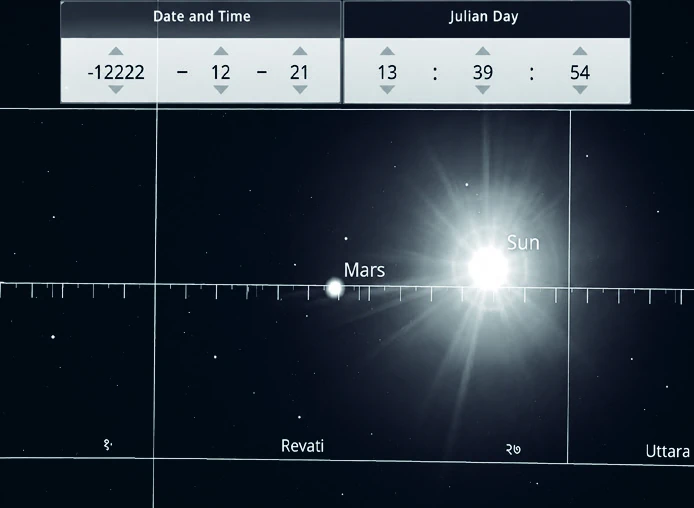
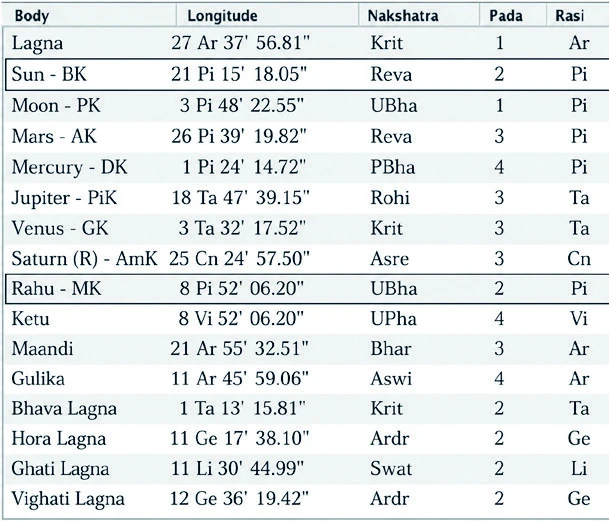
against the proposed date, 5114 BCE5114 BCE: Rāhu stood in Svātī
Pushkar Bhatnagar, Saroj Bala, and Jayasree Saranathan have proposed 5114 BCE as the year of Śrī Rāma’s birth. Based on this chronology, the Rāma–Rāvaṇa war would have taken place around 5077 BCE.
Accordingly, the relevant Sun–Mars conjunction occurred on 21 December 5092 BCE. On that date, the Sun was positioned in the fourth pāda of Dhaniṣṭhā nakṣatra, while Mars occupied the first pāda of the same nakṣatra. However, Rāhu was located in the fourth pāda of Svātī nakṣatra and was therefore not part of the conjunction.
Thus, none of the proposed Rāmāyaṇa chronologies has yet successfully demonstrated the occurrence of the specific conjunction of the Sun, Mars, and Rāhu described as an ominous celestial configuration during the year of Śrī Rāma’s planned coronation.
against Abhijit as the pole starBrahmarāśi is not the pole star
ब्रह्मराशिर्विशुद्धश्च शुद्धाश्च परमर्षयः । अर्चिष्मन्तः प्रकाशन्ते ध्रुवं सर्वे प्रदक्षिणम् ॥
अथ पवनसमानविक्रमाः प्लवगवराः प्रतिलब्धपौरुषाः । अभिजिदभिमुखां दिशं ययुः जनकसुता परिमार्गणोन्मुखाः ॥
पञ्चदशवर्षशतं प्रोष्योदितः पश्चिमेनांगुलिपर्वमात्रां शिखां दक्षिणाभिनतां कृत्वा कलिकेतोश्चारान्ते नभस्त्रिभागमनुचरन् यथा यथा चोत्तरेण व्रजति तथा तथा शूलाग्रकारां शिखां दर्शयन् ब्राह्मनक्षत्रमुपसृज्यात्मना ध्रुवं ब्रह्मराशिम् सप्तर्षीन् स्पृशन् नभसः अर्धमात्रं दक्षिणमनुक्रम्यास्तं व्रजति ॥
“The comet Calaketu, rising 115 years after Kaliketu in the west, with a tail resembling the length of a finger joint and inclined southward, traverses one-third of the sky. As it moves northward, displaying a head shaped like the tip of a trident, it approaches the Brāhma Nakṣatra (Abhijit), then touches Dhruva, Brahmarāśi, and the Saptarṣis, before turning southward and setting after traversing half the sky.” p. 401
वक्रानुवक्रं कृत्वा च श्रवणे पावकप्रभः । ब्रह्मराशिं समावृत्य लोहिताङ्गो व्यवस्थितः ॥
In Sanskrit, a viśeṣaṇa (adjective) must agree with its viśeṣya (noun) in both vibhakti (case) and vacana (number).
Brahmarāśiḥ and paramarṣayaḥ are in the nominative, the subjects of the verb; dhruvam is in the accusative:
Since these words are in different cases, they cannot stand in a viśeṣaṇa–viśeṣya relationship.
The verse therefore describes the Brahmarāśi group of stars and the Saptarṣis are revolving around Dhruva (the pole).
Of the Kiṣkindhākāṇḍa's “the direction facing Abhijit”:
This indicates that Abhijit is treated as a distinct celestial reference point, separate from Brahmarāśi.
The passage in the Parāśaratantra clearly identifies Brāhma nakṣatra (Abhijit), Dhruva, Brahmarāśi, and the Saptarṣi constellation as four distinct celestial reference points encountered by the comet.
This verse indicates that Mars (Lohitāṅga), after executing retrograde motion, entered Śravaṇa nakṣatra and became positioned in Brahmarāśi. This implies that Śravaṇa and Brahmarāśi lay along the same ecliptic region. On this basis, it is more plausible to identify Brahmarāśi with the constellation Cygnus or the sign of Capricorn (Makara Rāśi), rather than Lyra.
The same Mars verse, read on the war page: Mars in Śravaṇa, a week before the war.
Lanka, the Setu and Sugrīva's world
Measured with a yojana of about 128.7 metres, the epic's distances fit the land and the sea of the sixth millennium BCE: a Setu about 13 km long, an Ayodhyā 1.5 km long, a Lanka high on a mountain (pp. 402–412).

The units
- 1 aṅgula1.6764 cm
- 96 aṅgulas = 1 dhanuṣa1.6093 m
- 80 dhanuṣas = 1 yojana128.744 m
- 100 yojanas12.87 km
The epic's measures, in metres
- The Setu 100 yojanas long≈ 12.87 kmp. 403
- Ayodhyā 12 yojanas by 3≈ 1.54 km by 386 mp. 404
- Lanka on Trikūṭa 30 yojanas above the earth≈ 3,861 m, an ascentp. 411
- Rāvaṇa's palace 1 yojana by ½≈ 128.7 m by 64.5 mp. 411
- Mount Meru 100 yojanas high; Āryabhaṭa's “one yojana”≈ 12.87 kmpp. 403, 405
6200–5600 BCESri Lanka becomes an island
Geological evidence indicates that Sri Lanka remained connected to the Indian peninsula until at least 6200 BCE.
One of the most significant events in this process was the Meltwater Pulse 1C (MWP-1C), which occurred approximately between 6200–5600 BCE. During this interval, global sea levels rose by roughly 6–7 meters within a relatively short span of time.
The Setu (bridge) described in the Rāmāyaṇa likely involved raising or reinforcing an existing shallow ridge. It is plausible that Nala elevated the structure by a modest margin—perhaps up to ~2 meters through landfilling.
This implies that the submerged stretch between Dhanushkodi and Talaimannar during the Rāmāyaṇa era was about 13 km, whereas today the shallow chain extends to roughly 48 km (≈30 miles).
1 yojana ≈ 128.7 mA yojana of 128.7 metres
इतो द्वीपे समुद्रस्य संपूर्णे शतयोजने । तस्मिन् लंका पुरी रम्या निर्मिता विश्वकर्मणा ॥
आयता दश च द्वे च योजनानि महापुरी । श्रीमती त्रीणि विस्तीर्णा सुविभक्ता महापथा ॥
दशावनिभ्यो दशकक्ष्येभ्यो दशयोक्त्रेभ्यो दशयोजनेभ्यः। दशाभीशुभ्यो अर्चताजरेभ्यो दश धुरो दश युक्ता वहद्भ्यः ॥
It appears that the yojana used during the Rāmāyaṇa era was much smaller—possibly about one hundredth of the later standard.
Archaeological findings indicate that 10 divisions of the Mohenjo-Daro scale are equal to a dhanurgaha or 4 angulas. Thus, the precise length of an angula works out to be 16.764 mm or 1.6764 cm.
Robert A. Bauslaugh's study of the stadion, the Greek measure, in Thucydides:
He concludes that Thucydides’ stadion ranged between 130 and 260 meters, with approximately 77% of the instances falling between 150 and 200 meters.
In this context, avani in Sanskrit is understood to denote fingers. The span of a wide-open palm (four fingers spread) may be approximated at about 12.87 cm. On this basis, ten avanis equal one kakṣya (12.87 cm × 10 = 1.287 m), ten kakṣyas equal one yoktra (12.87 m), and ten yoktras equal one yojana (128.7 m).
The Sarasvatī Satra counts 44 aśvinas, each 100 yojanas, from Plakṣa Prasravaṇa to Vinaśana:
The computed distance about 566 km (44 × 12.87 km) aligns well with the geography, supporting the identification of Uchana as Vinaśana, where the Sarasvatī River is believed to have disappeared along its southwestern course.
Sugrīva's four directions
| Direction and leader | The way | It ends at | Verses |
|---|---|---|---|
| EastVinata | From Ayodhyā and Prayāga across the Gaṅgā, Sarayu, Kauśikī, Yamunā and Śoṇa; through Videha, Kāśī, Magadha and Aṅga to Mount Mandāra; then to Yavadvīpa (Java) and Suvarṇadvīpa (Sumatra), and the Ṛṣabha mountain in Borneo. | Udaya, identified with Mount Kinabalu: the region of East Malaysia | Kiṣkindhākāṇḍa 4.40, pp. 406–407 |
| SouthAṅgada | Over the Vindhyas, the Narmadā, Godāvarī and Kṛṣṇā; through Daṇḍakāraṇya, the Andhras, Cholas, Pāṇḍyas and Keralas; to Agastya on the Malaya, the Pāṇḍya capital Kāvāṭapuram and Mahendragiri; then 100 yojanas (about 12.87 km) over the sea to Laṅkādvīpa and Bhogavatī, identified with Kandy. | Ṛṣabha, possibly Namunukula, the southernmost hill of Sri Lanka | Kiṣkindhākāṇḍa 4.41, p. 407 |
| WestĀrciṣmān, son of Mārīca | Through Saurāṣṭra, Bāhlīka, Śūra and Abhīra to the western ocean and Muraci (Karachi?); Hemagiri at the Indus mouth (the Kirthar range), Pāriyātra, Vajra (possibly Khuzdar), Cakravān (perhaps the Sulaiman range), Varāha and Meghavān (the Hindu Kush). | Meru, Sāvarṇi Meru, identified with Tirich Mir in the Hindu Kush | Kiṣkindhākāṇḍa 4.42, pp. 407–408 |
| NorthŚatabali | Through the lands of the Kurus, Madras, Kāmbojas, Yavanas, Śakas, Bāhlīkas and Daradas into the Himalaya; to Kāla (the Laila peak), Sudarśana (perhaps Nanga Parvat), Kailāśa and Alakāpurī, Krauñca and Maināka (perhaps Kamet). | Uttara Kuru, beyond the Śailodā (the Kishanganga or Neelum), and no farther | Kiṣkindhākāṇḍa 4.43, pp. 408–409 |
This detailed geographical account attributed to Sugrīva reflects the expanse of Indian civilisation during the Rāmāyaṇa era.
Where Lanka stood
Ujjain's meridianLanka on the equator
Lāṭadeva’s Sūrya Siddhānta identifies Ujjain (Avanti) as the prime meridian (0° longitude) and associates it with the point where this meridian intersects the Tropic of Cancer.
Within this framework, Lanka is conceived as the point where the equatorial line intersects the prime meridian.
In this interpretive tradition, the term Lanka came to denote the intersection of the equator and the Ujjain meridian.
30 yojanas ≈ 3.8 kmTrikūṭa is Pidurutalagala
त्रिकूटशिखरे लङ्कां स्थितां…
अर्धयोजनविस्तीर्णमायतं योजनं महत्। भवनं राक्षसेन्द्रस्य बहुप्रासादसंकुलम् ॥
Al-Biruni, as Vedveer Arya quotes him:
According to the Hindus, Lanka is the fortress of the demons. It is thirty yojanas above the earth… It is on account of Lanka and the island of Vadavāmukha (volcano) that the Hindus consider the south as foreboding evil.
The mountain Pidurutalagala, the highest peak in Sri Lanka, rises to about 2524 meters and lies within the central highlands.
It is therefore plausible to identify Trikūṭa Śikhara with Pidurutalagala.
If we adopt a yojana length of approximately 128.7 meters for the Rāmāyaṇa period, the statement that Lanka stood thirty yojanas above the earth corresponds to roughly 3,861 meters. This may not represent absolute elevation but rather the ascent from the foothills to the fortified summit, suggesting a route of about 3.8 km leading to the city.
NairṛtaSouth-west of Ayodhyā
The Rāmāyaṇa refers to the Rākṣasas as Nairṛtas, meaning those dwelling in the south-west direction. Taking Ayodhyā as the center point, Lankāpurī is situated in the south-west direction.
Further, the city of Laṅkāpurī was situated in the south-western part of the island of Sri Lanka.
 , full size
The people of the epic, and after Rāma
Vedveer Arya takes several of the epic's wonders as history: two Hanumāns and two Jāmbavāns, a flying vehicle, elephants with four tusks. He also dates Rāma's reign, and the line of Sītā's father (pp. 412–418).
11200–11100 BCE and Rāma's ageHanumān I and Hanumān II
नूनं व्याकरणं कृत्स्नम् अनेन बहुधा श्रुतम्। बहुव्याहरता अनेन न किंचित् अपशब्दितम् ॥
“Surely, he has thoroughly mastered grammar; though he speaks at length, not a single word is improperly uttered.” p. 414
Hanumān I is placed around 11200–11100 BCE, while a later Hanumān (Hanumān II) belongs to the Rāmāyaṇa era (5677–5577 BCE). This distinction explains why Jāmbavān narrates the historical account of Hanumān’s birth to Hanumān II.
Within this framework, both traditions can be explained: Hanumān I is linked to Tirumala, while Hanumān II is associated with Kiṣkindhā.
In Vedic (Chandas) Sanskrit, the term Kapi did not originally denote a monkey; its later association with Vānara (monkey) developed in classical (Laukika) Sanskrit.
Jain sources indicate that Kapi rulers bore a monkey emblem on their banners, while the Jain versions of the Rāmāyaṇa portray Hanumān, Sugrīva, and others as human figures rather than literal monkeys.
11180 BCE and Rāma's ageJāmbavān I and Jāmbavān II
According to Purāṇic accounts, Jāmbavān I was the son of Brahmā and the younger brother of Himavān, placing him around 11180 BCE.
The Jāmbavān II of the Rāmāyaṇa era (5677-5577 BCE) was also a king of the Rikśas and addressed as Kapiśreṣṭha.
Over time, however, the terms Kapi and Rikśa became identified with “monkey” and “bear” respectively in later Sanskrit usage.
16 December 5635 BCEThe Puṣpaka Vimāna
तं मेरुशिखराकारं निर्मितं विश्वकर्मणा
After conquering the city, Rāvaṇa also took possession of the famed Puṣpaka Vimāna, originally belonging to Vaiśravaṇa, who subsequently migrated north and became the ruler of Alakāpurī.
Its ascent is conveyed through the phrase “utpapāta vihāyasam”, meaning “it rose into the sky.”
Arguably, the Puṣpaka Vimāna may have been comparable in principle to a hot-air balloon. In this interpretation, natural silk could have been used as the fabric, while turpentine oil (Karpūra Tailam) may have served as fuel for a burner.
carvings at the gateFour-tusked elephants
त्रिविष्टपनिभं दिव्यं दिव्यनादविनादितम् । वाजिहेषितसंघुष्टं नादितं भूषणैस्तथा ॥ रथैर्यानैर्विमानैश्च तथा गजहयैः शुभैः । वारणैश्च चतुर्दन्तैः श्वेताभ्रनिचयोपमैः ॥ भूषितं रुचिरद्वारं मत्तैश्च मृगपक्षिभिः । राक्षसाधिपतेर्गुप्तमाविवेश गृहं कपिः ॥
उत्तमं राक्षसावासं हनुमानवलोकयन् । आससादाथ लक्ष्मीवान् राक्षसेन्द्रनिवेशनम् ॥ चतुर्विषाणैर्द्विरदैस्त्रिविषाणैस्तथैव च । परिक्षिप्तमसम्बाधं रक्ष्यमाणमुदायुधैः ॥
राघवश्च मया दृष्टश्चतुर्दष्ट्रं महागजम् । आरूढः शैलसङ्काशं चकास सह लक्ष्मणः ॥
Thus, the passage may refer to sculptural representations, carvings, or statues decorating the entrance rather than living four-tusked elephants guarding it.
From a paleontological perspective, fossil discoveries in the Indian subcontinent have not yet yielded evidence that mastodons, sinomastodons, or stegodons survived into the sixth millennium BCE.
Of Trijaṭā's dream of Rāma on a four-tusked elephant:
However, this vision occurred in a dream and therefore cannot be treated as direct evidence for the existence of such animals.
Taittirīya YajurvedaThe Vedas the epic names
The Rāmāyaṇa refers to the Taittirīya branch of Yajurveda.
Accordingly, Veda Vyāsa (11180–11080 BCE) and the later Vyāsa of the Mahābhārata era (3162 BCE) were distinct individuals.
In the Kiṣkindhākāṇḍa, Śrī Rāma remarks that Hanumān appears to have mastered the Rigveda, Yajurveda, and Sāmaveda, as well as the Vyākaraṇa (grammar).
This suggests that grammatical studies had already reached an advanced stage by the time of the Rāmāyaṇa, with multiple grammatical traditions in existence.
15 January 5634 – about June 5604 BCEEleven thousand years: thirty and a half
The Rāmāyaṇa states that Śrī Rāma reigned for 11,000 years.
If the figure of 11,000 is divided by 360, it yields approximately 30 years and 6 months as the effective duration of his reign. Based on this framework, it is plausible that Śrī Rāma ascended the throne of Ayodhyā around December 5635 BCE and ruled until approximately June 5604 BCE.
Kuśa, the son of Śrī Rāma, is said to have ascended the throne of Ayodhyā around 5604 BCE, following Śrī Rāma’s departure from the mortal world.
5680–5620 BCESīradhvaja Janaka, twentieth after Udāvasu
The Purāṇas and the Rāmāyaṇa state that King Sīradhvaja Janaka of Mithilā was the father of Sītā. In tracing his genealogy, the Purāṇas indicate that Sīradhvaja Janaka was the twentieth descendant of Udāvasu.
It appears that Udāvasu, the king of Mithilā, was a contemporary of the Ayodhyā ruler Śruta (or Prasuśruta), who reigned approximately between 6250–6220 BCE.
The lineages of Ayodhyā and Mithilā remained distinct and independent since the Vedic period.
| Number | King | Reign |
|---|---|---|
| From Nimi | ||
| Nimi (son of Vaivasvata Manu) | 11230 BCE | |
| 1 | Devarāta, Mithi and Karāla | 11200–11170 BCE |
| 2 | Indradyumna | 11170–11140 BCE |
| 3 | Devamīḍha | 11140–11110 BCE |
| 4 | Madhu | 11110–11080 BCE |
| 5 | Videha Mādhava | 11080–11030 BCE |
| 6 | Janaka Vaideha | 11030–11010 BCE |
| 7 | Kratuvid, Khānḍikya, Mitadhvaja, Keśidhvaja, Dharmadhvaja | 11110–10990 BCE |
| 8 | Sāpya | 10990–10970 BCE |
| 9 | Nami | 10970–10950 BCE |
| The chronology of the Mithila kings between 10950 BCE and 6250 BCE is now lost. | ||
| 1 | Udāvasu | 6240–6200 BCE |
| 2 | Nandivardhana | 6200–6170 BCE |
| 3 | Suketu | 6170–6140 BCE |
| 4 | Devarāta | 6140–6110 BCE |
| 5 | Bṛhaduktha | 6110–6080 BCE |
| 6 | Mahāvīrya | 6080–6050 BCE |
| 7 | Dhṛtimān | 6050–6020 BCE |
| 8 | Sudhṛti | 6020–6000 BCE |
| 9 | Dhṛṣṭaketu | 6000–5970 BCE |
| 10 | Haryāśva | 5970–5950 BCE |
| 11 | Maru | 5950–5930 BCE |
| 12 | Pratitvaka | 5930–5910 BCE |
| 13 | Kīrtiratha | 5910–5880 BCE |
| 14 | Devamīḍha | 5880–5850 BCE |
| 15 | Vibudha | 5850–5820 BCE |
| 16 | Dhṛti | 5820–5790 BCE |
| 17 | Kīrtirāja | 5790–5760 BCE |
| 18 | Mahāroma | 5760–5740 BCE |
| 19 | Svarṇaroma | 5740–5710 BCE |
| 20 | Hrasvaroma | 5710–5680 BCE |
| 21 | Sīradhvaja Janaka | 5680–5620 BCE |
Sources
Every quotation, verse, table and figure above is from chapter 7 of Chronology of India: From Manu to Mahabharata (2026), “Seventh Mahāyuga (7322 BCE) and the Rāmāyaṇa Age (5677–5577 BCE)”, pages 360 to 418, and its Appendix II, “A Comparative Study of the Genealogy of Śrī Rāma”, pages 672 to 677, except the passages marked with another of its chapters (2, 4, 8 and 9). The same chronology appears in his earlier books, The Chronology of India: From Mahabharata to Medieval Era (2019) and Chronology and Origins of Indo-European Civilizations, Vol. 2 (2025).
