
Calendars
Two tools for old dates: the original weekday of any date, and the day of the Egyptian year for any Julian date.
On this page
The weekday of a date
Every date has two weekdays here: the original weekday, by the Sūrya Siddhānta's day count, and the calendar's weekday, the Julian calendar's, four days behind it.
Or try a date from the records
Its answer shows here: a date's original weekday, its calendar's weekday, and its Sūrya Siddhānta day.
The Egyptian calendar
Turns a day of the Egyptian year into a Julian date, and a Julian date into its Egyptian day, in the calendar as Vedveer Arya reconstructs it, counted from the midnight rising of Sirius on 26 September 3605 BCE.
Or try a date from the records
Its answer shows here: the date's day of the Egyptian year, its year and its cycle.
Its answer shows here: the day's Julian date.
The Sūrya Siddhānta Day
Mayāsura's Sūrya Siddhānta began the seven-day week on Sunday, 22 February 6778 BCE (20 February with ΔT), the day the Sun, the Moon and the five visible planets met in Aries. Count the days from that Sunday, day 0, and every later day has the weekday its own people gave it. That count is the Sūrya Siddhānta Day.
Why the weekdays are four days off
In the Julian calendar the spring equinox comes about a day earlier every 134 years, and by the 16th century it had moved from 21 March to 11 March. In 1582 Pope Gregory XIII took 10 days out of the calendar to put it back: Thursday, 4 October, was followed by Friday, 15 October.
Ten was too few. The reformers counted the drift from the middle of the 3rd century CE, when they believed the equinox had been 21 March. Corrected for the 661-year error, the Council of Nicaea, which settled the date of Easter, met in 335 BCE, not 325 CE, and it fixed the equinox on 24 March. The 21st came later, with the Coptic calendar of the era of the Martyrs (284 CE). By 1582 the calendar had gathered 14 extra days. Gregory removed 10, and four were left in (Indo-European Civilizations, Vol. 1, p. 60).
The sign of it was already in the Church's own tables: the new moons in the sky came four days before the dates the tables gave, and Gregory had to move the Church's lunar cycle to match (p. 61).
Gregory XIII, 158210 days removed: 5 to 14 October
- 30Sun
- 1Mon
- 2Tue
- 3Wed
- 4Thu
- 5–14removed
- 15Fri
- 16Sat
- 17Sun
Vedveer Arya's correction14 days removed: 1 to 14 October
- 30Sun
- 1–14removed
- 15Mon
- 16Tue
- 17Wed
Every weekday the Julian calendar gives for a date before 1582 is counted back from that Friday: Joseph Scaliger built his count of Julian years that way, back to 1 January 4713 BC (Vol. 1, p. 59). So each one is four days off. The conversion (Table 3.13), which this tool applies:
| Original weekday | Calendar's weekday |
|---|---|
| Sunday | Wednesday |
| Monday | Thursday |
| Tuesday | Friday |
| Wednesday | Saturday |
| Thursday | Sunday |
| Friday | Monday |
| Saturday | Tuesday |
Vedveer Arya calls for a further reform of the Gregorian calendar, removing the four days to restore the original weekdays (p. 107). Until then the weekdays in use run four days behind the count. The tool shows both for every date.
What the records say
Records that name a date together with its weekday show the four days. Each one below can be checked with the tool above.
A graffito at Pompeii
the calendar's weekday, Wednesday ; the original weekday, Sunday 4 February 594 BCE
Nerone Caesare Augusto / Cosso Lentulo Cossi fil. Cos. / VIII idus Febr(u)arius / Dies Solis, luna XIIIIX,
nun(dinae) Cumis, V (idus Februarius) nun(dinae) Pompeis
“When Nero Caesar Augustus and Cossus Lentulus, son of Cossus, (were consuls), eight days before the ides of February, Sunday, the 16th day of the moon, the nundinae at Cumae, five days before the ides of February the nundinae at Pompeii.”
Written under the consuls Nero and Cossus Lentulus, it names 6 February 594 BCE the day of the Sun, Sunday, and the 16th day of the moon. In the Julian calendar the day is 4 February 594 BCE, and a Wednesday (Vol. 1, pp. 62–63).
- Claim
- Historians date the graffito to
the conventional date, 6 February 60 CE, a Wednesday, and explain its Sunday by two ways of naming the days, one counted from sunset and one from sunrise. - Why it's wrong
- Sunset and sunrise are 12 hours apart, not four days, and nothing shows one way calling the day Sunday and the other Wednesday.
- Corrected
- The Sunday is the day's own name. The rebuilt calendar is four days off.
An eclipse on the Kurtakoti copper plate
the calendar's weekday, Wednesday ; the original weekday, Sunday 9 May 53 BCE
The plate, found in Karnataka, records a total eclipse of the Sun on a Sunday: 9 May 53 BCE. The Julian calendar makes that day a Wednesday (Vol. 1, p. 67).
Polycarp and Pionius of Smyrna
the calendar's weekday, Tuesday ; the original weekday, Saturday 11 March 494 BCE
Polycarp, bishop of Smyrna, was martyred on a Saturday, 12 March 494 BCE. Pionius was martyred 84 years later on the anniversary, 12 March 410 BCE, also a Saturday, a “great Sabbath”. In the rebuilt calendar both days are 11 March, and both are Tuesdays (Vol. 1, pp. 66–67).
The first Easter
the calendar's weekday, Wednesday ; the original weekday, Sunday 3 April 629 BCE
Corrected for the 661-year error, Jesus was crucified on Friday, 1 April 629 BCE, and rose on Sunday, 3 April 629 BCE. The rebuilt Julian calendar makes 3 April 629 BCE a Wednesday (Vol. 1, p. 60).
Āryabhaṭa and the Śakānta era
the calendar's weekday, Sunday ; the original weekday, Thursday 5 March 3173 BCEthe calendar's weekday, Wednesday ; the original weekday, Sunday 1 April 78 CE
Counting from Sunday, 22 February 6778 BCE (20 February with ΔT), Āryabhaṭa dates the start of the 28th Kaliyuga to a Thursday (Gurudivasa), 5 March 3173 BCE. The Śakānta era began on a Sunday, 1 April 78 CE (Vol. 1, p. 106). The Julian calendar makes them a Sunday and a Wednesday.
Two days more: Caesar's early calendar
The Julian calendar began in 704 BCE. To catch the old Roman calendar up with the seasons, its last year, 705 BCE, ran to 445 days, and the new calendar's first day was set two days early, on what the rebuilt calendar calls 30 December 705 BCE, so that 25 March stayed the spring equinox and 25 December the winter solstice (Vol. 1, pp. 64–66). For 36 years the priests then added a leap day every third year instead of every fourth, until Augustus left out twelve years' leap days, as Macrobius records (p. 65).
So a date written in Caesar's early calendar can differ from the rebuilt one by a day or two: the graffito's 6 February is 4 February, and Polycarp's 12 March is 11 March. The tool reads the rebuilt Julian calendar; Vedveer Arya gives that date beside the early one.
Fact Card704 BCE – 1582 CEGregory's 1582 reform left four extra days in the Julian calendarThe first Sunday
The Sūrya Siddhānta records the sky of its own time: “At the end of this Kṛta Yuga, all the planets are in conjunction in the first degree of Aries, excepting their nodes and apsides.” A search of NASA's JPL DE441 ephemeris finds the Sun, the Moon and the five visible planets together like that, with the Sun in the first degree of Aries, only once in the last 20,000 years (From Manu to Mahabharata, p. 26).
The ephemeris gives the day as 22 February 6778 BCE. Allowing for the slowing of the Earth's rotation (ΔT, after Morrison and Stephenson, 2004) moves it to 20 February, the day as it fell in India. The seven bodies stood closest, within about 26° of Aries, near 0:00 UT, 6 a.m. in India, that day, which is why Mayāsura began the day, a Sunday, at 6 a.m. that morning (From Manu to Mahabharata, pp. 26, 31). The Sūrya Siddhānta's count of days starts on 20 February as day 0 (From Manu to Mahabharata, p. 37).

From that Sunday Mayāsura counted a week of seven days, each named for the planet that rules its first hour. The Sūrya Siddhānta gives the rule: “Counting downward from Saturn, the fourth successively is regent of the day” (12.78; Vol. 1, p. 105). Take the planets in its order, from Saturn down, and count four each time, starting from the planet itself:
- SaturnSaturday
- JupiterThursday
- MarsTuesday
- SunSunday
- VenusFriday
- MercuryWednesday
- MoonMonday
Saturn's day is followed by the Sun's, the fourth from Saturn; the Sun's by the Moon's, the fourth from the Sun; and so round the week: Sunday, Monday, Tuesday, Wednesday, Thursday, Friday, Saturday.
- Claim
- The seven-day week began with the Babylonians, who made the Sabbath, Saturday, its sacred day, and the Jews, the Romans and the Christians took it from them.
- Why it's wrong
- The Sūrya Siddhānta's week is dated by its own sky, and it began on a Sunday in 6778 BCE.
- Corrected
- The planetary week began in India, with Mayāsura, and Sunday was its first day (Vol. 1, pp. 104–106; From Manu to Mahabharata, p. 37).
Vedveer Arya calls for renaming the count of days astronomers keep, the Julian Day, which runs from 1 January 4713 BC, as the Sūrya Siddhānta Day, counted from this Sunday as day 0 of year 0 (Vol. 1, p. 106; From Manu to Mahabharata, p. 37). The tool's day numbers are that count.
Fact Card6778 BCEThe Sūrya Siddhānta's all-planet conjunction fell on Sunday 22 February 6778 BCE (20 February with ΔT)The Sothic cycles
The anchor is the midnight rising of Sirius: the night the star rose at midnight, the hour the Egyptian day began, not its heliacal rising, its first sight just before dawn (The midnight rising of Sirius, below).
| Cycle | Began | Ended |
|---|---|---|
| First | 26 September 3605 BCE | 25 September 2145 BCE |
| Second | 26 September 2145 BCE | 25 September 685 BCE |
| Third | 26 September 685 BCE (31 October after the reform of 522 BCE) | after 290 BCE, where the reconstruction ends |
How the Egyptian year worked
The Egyptian civil year had 365 days: twelve months of 30 days, and five more at the end of the year, the epagomenal days. It had no leap day. The months fell in three seasons of four (Vol. 1, pp. 181, 184):
| Month | Akhet | Peret | Shemu |
|---|---|---|---|
| I | Thoth | Tybi | Pachons |
| II | Phaophi | Mechir | Payni |
| III | Athyr | Phamenoth | Epiphi |
| IV | Choiak | Pharmuthi | Mesore |
So III Shemu 9 is the 9th day of the third month of Shemu, Epiphi, the 309th day of the year. Akhet means the end of the floods: the Nile rose in July, August and September, and the year began as the waters fell (p. 184).
The Sun's year is about a quarter of a day longer than 365 days. So the Egyptian New Year's Day, 1 Thoth, came a day earlier every four years, through every season, until after 1,460 Julian years, which are 1,461 Egyptian years, it was back where it began: one Sothic cycle (p. 182). The kings kept it so. Each, as Nigidius Figulus records, swore at his accession before the priest of Isis “not to intercalate either days or months, but to retain the year of 365 days as established in ancient times” (p. 185).
The end of the second cycle fixes the rest. Theon of Alexandria says a cycle of 1,460 years ended in the fifth year of Augustus, and Censorinus and Abul Fazl both date the Augustan era of Alexandria from 689 BCE, so that year was 685 BCE (pp. 182–183). The Nabonassar era's first New Year's Day, 1 Thoth, fell on 25 March 1408 BCE; 723 Egyptian years later New Year's Day had moved back 181 days, and the second cycle ended on 25 September 685 BCE (p. 183). Two cycles earlier, the first began on 26 September 3605 BCE.
The midnight rising of Sirius
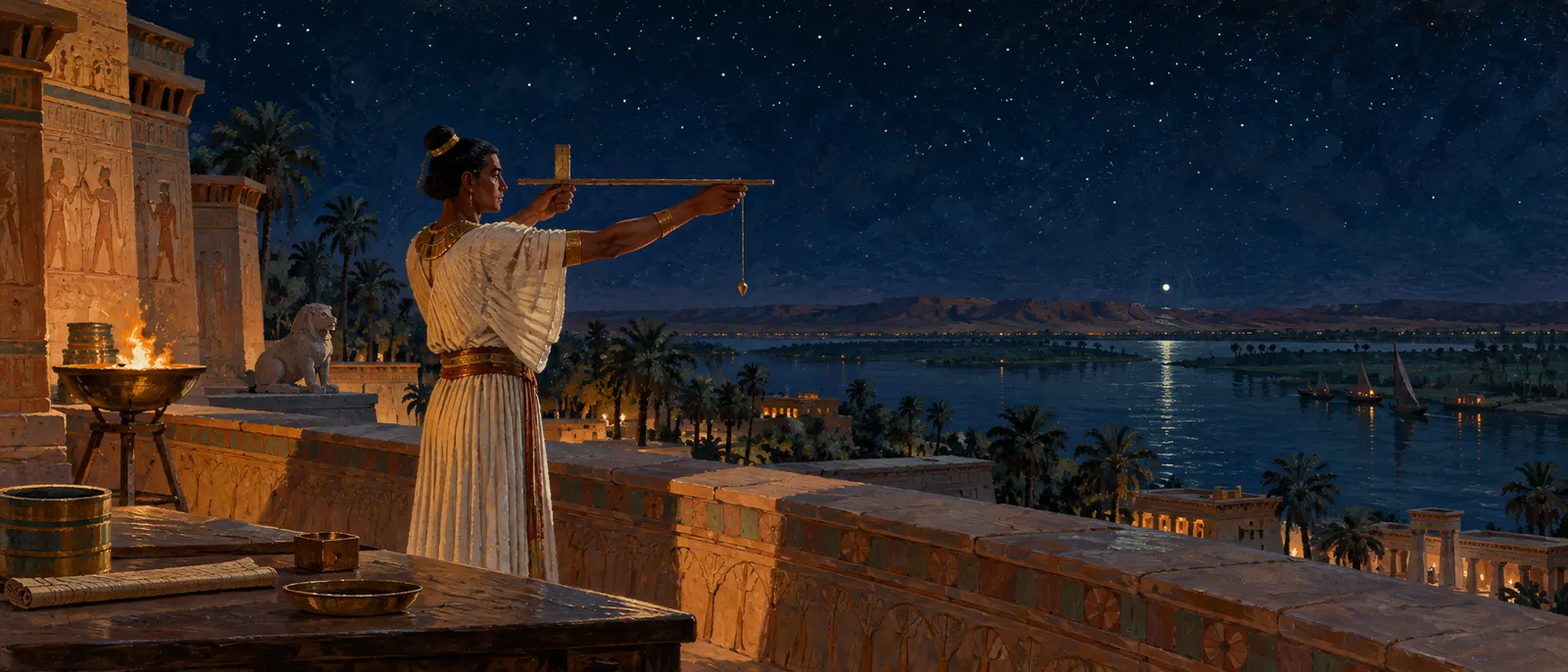
The Egyptians began their day at midnight. Their sundials divided the day and the night into twelve hours each; at sunset the shadow was gone, and at midnight a new count of hours began. So they began the year on the night Sirius, Sothis, “the opener of the year”, rose at midnight, and in Egypt that night fell on 26 September, as the floods ended (Vol. 1, pp. 183–184).
- Claim
- The calendar followed the heliacal rising of Sirius, its first
appearance just before dawn, around 19 July, and the first Sothic cycle began on
the conventional date, 19 July 2781 BCE(Eduard Meyer, in 1904, began the calendar inthe conventional date, 4241 BCE). - Why it's wrong
- The Egyptian year began at midnight, not at dawn, and the dated records fit the midnight rising of 26 September. Egyptologists' dates also carry the 661-year error and the 165 years missing from Jewish chronology: 826 years in all.
- Corrected
- The first cycle began at the midnight rising of Sirius on 26 September 3605 BCE, in the reign of King Djer (Vol. 1, pp. 182, 189, 624).
Seven records of the rising fix it (pp. 185–188). Each names the day of the Egyptian year on which Sirius rose at midnight, and the book dates each to 26 September:
- The Ilahun papyrusyear 7 of a king whose name is lost: IV Peret 16, 26 September 2701 BCE
- An inscription at Gebel Tjautiyear 11 of a king whose name is lost: II Shemu 20, 26 September 2449 BCE
- The Ebers papyrusyear 9 of Dsr-k3-Rc: III Shemu 9, 26 September 2373 BCE
- The Hyksos king AssethIII Shemu 15, 26 September 2349 BCE
- The temple of Khnum, ElephantineIII Shemu 28, 26 September 2297 BCE
- Sethos's cenotaph“all these stars begin on 1 Akhet when Sirius appears”: his accession on I Akhet 1, 26 September 2145 BCE, the first day of the second cycle
- The Notice of Meneptahyear 2: I Akhet 29, 26 September 2033 BCE
The reform of 522 BCE
Censorinus, writing in 422 BCE, gives two Egyptian New Years a century apart: the seventh day before the kalends of September, 26 August, in 422 BCE, and the twelfth before the kalends of October, 20 September, in 522 BCE, a year he calls a “great year” (Vol. 1, p. 189).
It was great in length. In 522 BCE the Egyptians lengthened that year, the only reform of the period, to bring the calendar into step with the Moon (pp. 189–190). From then on the third cycle was counted as if it had begun on 31 October 685 BCE instead of 26 September, 35 days later (p. 271).
The astronomers of Alexandria, Theon among them, kept the reformed count, and so does Papyrus Carlsberg 9, whose table of new moons runs in cycles of 25 Egyptian years, 309 lunar months: its last cycle begins on I Akhet 1, 18 September 513 BCE. The Egyptians who kept to the old ways went on counting from 26 September, and so did Claudius Ptolemy (pp. 190, 270–271). For any date from 31 October 685 BCE, the tool gives both readings.
- 513 BCEI Akhet 118 Sep
- 512 BCEI Akhet 206 Oct
- 511 BCEI Akhet 925 Sep
- 510 BCEI Akhet 2814 Oct
- 509 BCEI Akhet 184 Oct
- 508 BCEI Akhet 722 Sep
- 507 BCEI Akhet 2611 Oct
- 506 BCEI Akhet 1530 Sep
- 505 BCEI Akhet 419 Sep
- 504 BCEI Akhet 248 Oct
- 503 BCEI Akhet 1327 Sep
- 502 BCEI Akhet 216 Sep
- 501 BCEI Akhet 215 Oct
- 500 BCEI Akhet 1023 Sep
- 499 BCEI Akhet 3013 Oct
- 498 BCEI Akhet 192 Oct
- 497 BCEI Akhet 821 Sep
- 496 BCEI Akhet 279 Oct
- 495 BCEI Akhet 1628 Sep
- 494 BCEI Akhet 618 Sep
- 493 BCEI Akhet 257 Oct
- 492 BCEI Akhet 1425 Sep
- 491 BCEI Akhet 314 Sep
- 490 BCEI Akhet 223 Oct
- 489 BCEI Akhet 1223 Sep
